Chlebíčky: The Czech Party “Sandwich” That’s Basically a Law on New Year’s Eve
If you’re spending Silvestr (New Year’s Eve) in Czechia, you’ll notice something magical happens around 6–7 pm.
People who normally claim they “don’t eat bread” suddenly gather around a tray of open-faced sandwiches and politely turn into seagulls.
Welcome to chlebíčky (pronounced roughly khleb-eech-kee): the most Czech way to say “I love you, but I’m not cooking a hot meal.”
So… what is a chlebíček?
A chlebíček is a Czech open-faced sandwich, usually made on a slice of soft white bread called veka, with a base layer (often bramborový salát, aka potato salad) and then a carefully “decorated” mountain of toppings: ham, cheese, egg, pickles, roasted pepper, herbs, sometimes even shrimp because why not.
It’s like a canapé that grew up, got a job, and now carries the entire national party culture on its back.
Want to find out more about this Czech gastro-phenomenon? Watch this video of Kluci z Prahy.
When do Czechs eat chlebíčky?
Short answer: whenever there are people.
Longer answer:
Silvestr (New Year’s Eve) – the classic: chlebíčky + sparkling wine + someone saying “Let’s just have one drink.” (Lies.)
Birthday parties – the tray appears like a ritual object.
Visits (“jen na kafe”) – the most dangerous phrase in Czech, because it never means just coffee.
Work celebrations & office snacks – where your boss becomes a philosopher after two chlebíčky and a deci of wine.
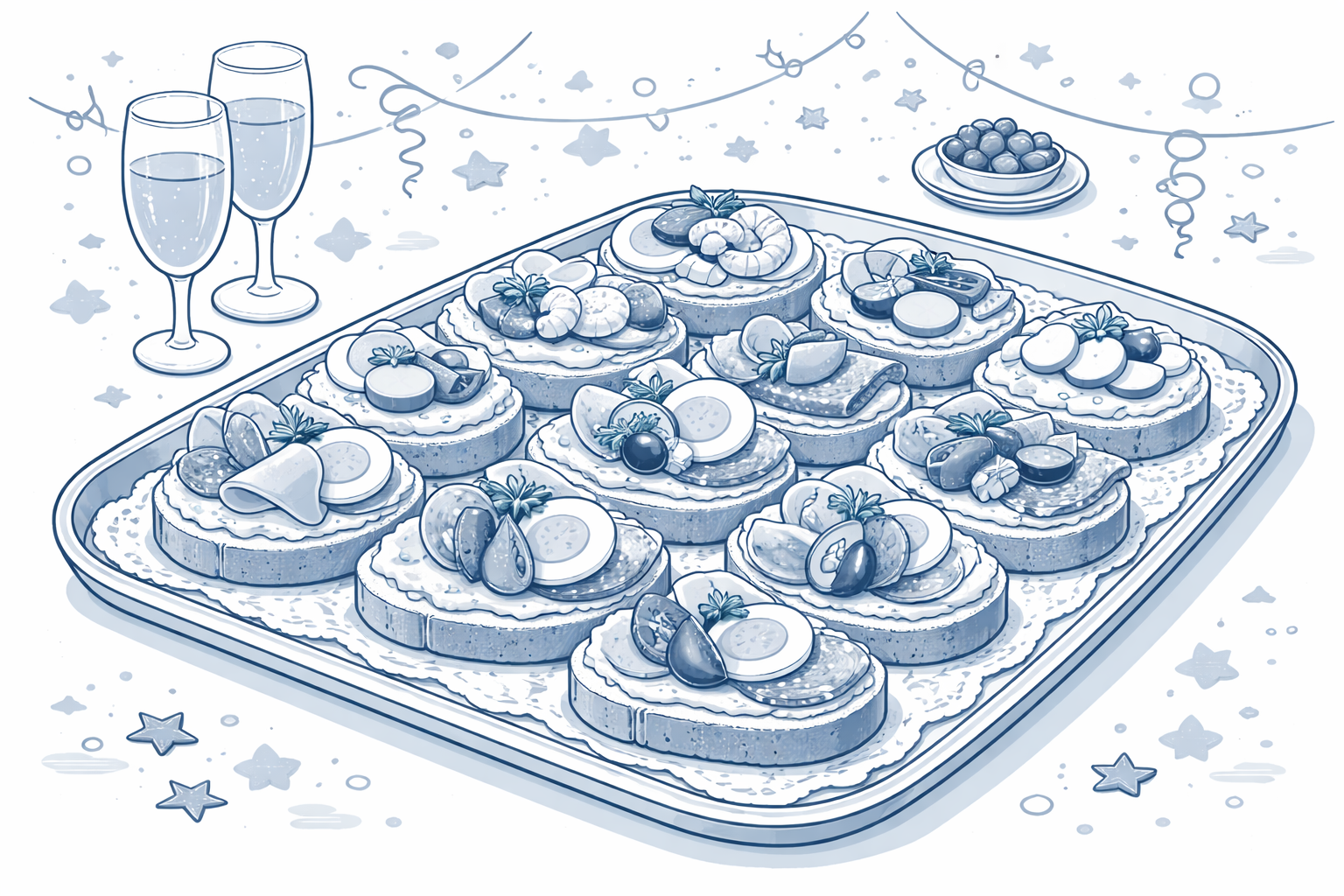
They’re popular because you can make a lot, they look fancy, and nobody needs a plate… until they do.
How chlebíčky are made (the Czech way)
Chlebíčky are not “assembled.” They are built. Like architecture. Like Prague.
Typical structure:
Bread: veka (or baguette in some modern places)
Base: potato salad / butter / spread (pomazánka)
Main topping: ham, salami, cheese, roast beef, egg, etc.
Decoration: pickles, tomato, pepper, onion, parsley… and one olive that will roll off at the worst possible moment
Pro tip: In Czech delis you’ll often see prices per piece (za kus) or by weight (za 100 g). This can be confusing, emotional, and occasionally surprising at the cash register.
Where to buy great chlebíčky in Prague (without a treasure hunt)
Traditional Czech delis – classic flavors, potato salad exactly how your Czech friend’s grandma likes it.
Modern bistros – more creative toppings, prettier presentation, still very Czech.
Cafés and pastry shops – you go in for cake, leave with sandwiches. This is normal here.
Typical prices: roughly 40–80 CZK per piece, depending on location and toppings.
Translation: cheap enough to buy “just two,” expensive enough to end up buying six.
Handy Czech vocabulary for surviving a chlebíček situation
Core words
chlebíček (pl. chlebíčky) = open-faced sandwich
obložený = “garnished / loaded” (literally “covered”)
veka = soft white bread used for chlebíčky
bramborový salát = potato salad
pomazánka = spread
šunka = ham
uherák = Hungarian-style salami
okurka = pickle/cucumber
vajíčko = egg
Ordering phrases
Prosím jeden chlebíček. = One chlebíček, please.
Jaké máte chlebíčky? = What chlebíčky do you have?
Dám si tenhle. = I’ll take this one.
Je to za kus, nebo za 100 gramů? = Is it per piece or per 100 grams?
Most realistic Czech sentence on December 31
Dám si už jen jeden. = “I’ll have just one more.” (No Czech has ever meant this.)
Mini Silvestr emergency recipe: make chlebíčky at home
If you want to DIY (or you’re abroad and Prague isn’t delivering to your kitchen), here’s the classic method.
Ingredients
veka (or soft white baguette)
bramborový salát (store-bought is socially acceptable)
ham or salami
cheese
hard-boiled eggs
pickles
optional: roasted red pepper, parsley, mayo, mustard
Assembly (important: confidence)
Slice the bread.
Spread a thick layer of potato salad.
Add meat and cheese.
Place egg and pickle.
Decorate until it looks slightly absurd.
Chill for 30–60 minutes so it officially becomes “party food.”
Serving rule: Put them on a tray. Step back. They will disappear.
Chlebíčky are not just food. They are hospitality, celebration, and proof that Czechs can make anything a party as long as there’s bread and something on top of it. And on Silvestr? If there are no chlebíčky, people will ask questions.
