Why Do Czech Prepositions Suddenly Grow an Extra Letter?
You’re happily learning Czech. You finally understand cases (well… most of the time). You know that k means "to," v means "in," s means "with," and z means "from."
Life is good. Then one day your teacher casually says: Jdu ke škole.
Wait...
Ke?
Yesterday it was k.
The next day someone says: Jsem ve škole.
Hold on.
Now it's ve?
Then you hear: Půjdeš se mnou?
Not s mnou?
And just when you think you've seen it all: To je ode mě.
ODE?!
At this point, it feels like Czech prepositions are secretly evolving whenever you're not looking. Fortunately, there's good news. This isn't random at all. In fact, Czech is doing you a favor.
Czech Doesn't Like Tongue Twisters
Imagine trying to say these out loud: k škole, v škole, s mnou, z stolu
Not exactly smooth, is it? Czech loves words that are easy to pronounce. Whenever two difficult groups of consonants crash into each other, the language often slips in a little helper vowel.
It's the linguistic equivalent of putting a pillow between two people arguing on a couch. That extra vowel makes everything flow much more naturally.
Think of it like English changing a to an before a vowel. The meaning doesn't change. The pronunciation just becomes much easier.
K → KE
The preposition k means to or towards.
Most of the time, it's just k.
Jdu k doktorovi. = "I'm going to the doctor."
Přijel k babičce. = "He came to his grandmother's house."
But before some words, Czech prefers ke.
You'll hear this all the time.
Jdu ke škole. = "I'm walking towards the school."
Pojď ke mně. = "Come to me."
Sedni si ke mně. = "Sit next to me."
Přijeli jsme ke kamarádům. = "We arrived at our friends' place."
Klíče dej ke dveřím. = "Put the keys by the door."
Expressions you should simply memorize
ke mně
ke škole
ke dveřím
ke kamarádovi
ke dvěma lidem
If you're unsure, listen to native speakers. Some combinations simply sound much more natural with ke.
V → VE
This is probably the version you'll hear the most.
Students often ask: Why is it ve škole, but v Praze?
Because Czech likes easy pronunciation.
Compare these:
Bydlím v Praze. = "I live in Prague."
Jsem v práci. = "I'm at work."
Byli jsme v restauraci. = "We were in a restaurant."
Now compare:
Jsem ve škole. = "I'm at school."
Bydlím ve Francii. = "I live in France."
Setkáme se ve středu. = "We'll meet on Wednesday."
Ve dvě hodiny mám schůzku. = "I have a meeting at two o'clock."
Děti jsou ve třídě. = "The children are in the classroom."
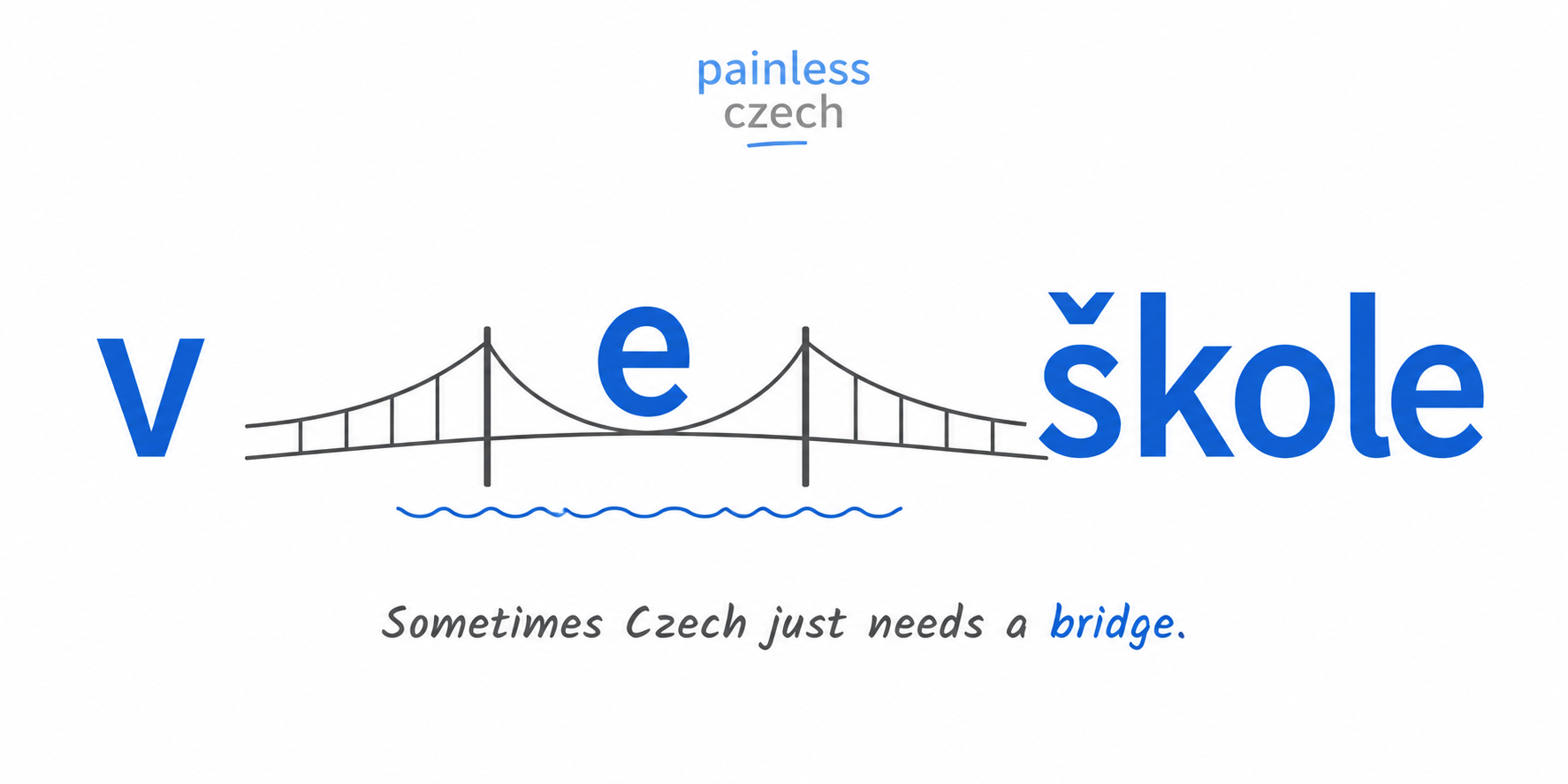
Notice how ve makes these combinations much easier to pronounce.
S → SE
This one catches almost every Czech learner.
You'll naturally want to say: s mnou
Native speakers say:
✔ Půjdeš se mnou? = "Will you come with me?"
More examples:
Bydlím se sestrou. = "I live with my sister."
Mluvím se sousedem. = "I'm talking to my neighbour."
Jdeme se psem na procházku. = "We're taking the dog for a walk."
Se dvěma dětmi je pořád veselo. = "With two children there's always something happening."
When a word begins with a difficult combination of consonants, seoften sounds much better thans.
Z → ZE
Exactly the same story. Most of the time, Czech uses z.
Jsem z Prahy. = "I'm from Prague."
Přišel z práce. = "He came from work."
But sometimes you'll hear ze.
Jdu ze školy. = "I'm coming from school."
Spadl ze stolu. = "It fell off the table."
Přiletěli ze Španělska. = "They flew back from Spain."
Vyšel ze dveří. = "He walked out of the door."
Again, the extra vowel simply makes pronunciation easier.
O → ODE
This one surprises many students because it's much less common. But you've definitely heard it.
To je ode mě. = "This is from me."
Utíkal ode dveří. = "He ran away from the door."
So... Is There a Rule?
Yes. And also... Not really. The official explanation involves pronunciation and phonetics. The practical explanation is much easier.
Here's the good news: you don't need to memorize dozens of rules. In most cases, Czech adds an extra e when the next word begins with the same consonant as the preposition (ve Vídni, ze Znojma, se sestrou, ke Karlovi) or when the preposition would otherwise be followed by a difficult consonant cluster (ve škole, se mnou, ze školy, ke mně). The goal is always the same: to make the phrase easier to pronounce. There are a few exceptions, but this simple guideline will help you get it right most of the time.
A Tiny Trick That Works
Don't ask yourself: "Should I use v or ve?"
Instead, ask yourself: "Which one is easier to say?"
Most of the time, Czech has already made the same decision. This is one of those little details that makes Czech sound wonderfully natural. Native speakers don't consciously think about it. They simply choose the version that rolls off the tongue more easily.
And once you start noticing these patterns, you'll hear them everywhere… in conversations, podcasts, films, and everyday life.
So next time someone says Pojď ke mně, don't panic. Your preposition hasn't mutated. It's just trying to make your life easier.
Want to Master Czech Prepositions?
If Czech prepositions still feel like a maze, I've got something that will save you a lot of frustration. My Czech Prepositions Cheat Sheet explains the most common Czech prepositions, the cases they require, and how they're used in real-life Czech with clear examples that you'll actually remember.

Master Czech prepositions once and for all! This beautifully designed Czech Prepositions Cheat Sheet explains the logic behind Czech prepositions — where to use do, v/ve, z/ze, na, u, od, s, bez, po, nad, pod, před, za and more.
You’ll finally understand why it’s ve škole but do práce, and how Czechs use prepositions to show movement, position, and direction.
Includes easy visuals, grammar tips, real-life examples, and humor that makes it all stick.
Perfect for A1–B2 students who want to sound natural and confident in Czech.
