Někdo, Nikdo, Kdokoliv or Každý? Czech Words That Look Similar (But Aren't)
Some Czech words are difficult because they're long. Some are difficult because they have too many consonants. And then there are words like někdo, nikdo, kdokoliv, and každý.
They look harmless. Most students know exactly what they mean… at least individually. But the moment it's time to choose the right one, everything falls apart.
Suddenly, someone becomes everyone, anyone becomes nobody, and one tiny word changes the meaning of the entire sentence.
The good news? The difference between these four words is actually much simpler than most textbooks make it seem.
Někdo = Someone
Let's start with the easiest one. Imagine you're sitting at home when the doorbell rings. You don't know who's outside. You simply know that there is a person.
So you say:
Někdo zvoní. = "Someone is ringing the doorbell."
The same idea appears in everyday conversations.
Včera mi někdo volal. = "Someone called me yesterday."
Někdo tady zapomněl klíče. = "Someone forgot their keys here."
Na autobusové zastávce na mě někdo čeká. = "Someone is waiting for me at the bus stop."
Někdo mi ukradl kolo. = "Someone stole my bike."
In every example, the person definitely exists. You just don't know who it is or you don't want to say. That's exactly what někdomeans.
Nikdo = Nobody
Now let's change just one word.
Nikdo nezvoní. = "Nobody is ringing the doorbell."
Completely different meaning.
Nikdo nepřišel. = "Nobody came."
Nikdo mi nepomohl. = "Nobody helped me."
Nikdo tomu nerozumí. = "Nobody understands it."
Nikdo není doma. = "Nobody is home."
Here's something that surprises almost every English speaker. English usually avoids double negatives. Czech loves them.
Look at these examples.
Nikdo nic neřekl. = "Nobody said anything."
Nikdo nikam nešel. = "Nobody went anywhere."
Nikdo nikdy nic neviděl. = "Nobody ever saw anything."
If you're learning Czech, don't be afraid of all those negative words. They're completely normal.
Někdo vs. Nikdo
Let's compare them directly.
Někdo mi pomohl. = "Someone helped me."
There was one person. You just don't know who.
Nikdo mi nepomohl. = "Nobody helped me."
There wasn't a single person. One little word changes the whole meaning.
Kdokoliv = Anyone
Now things become more interesting. Imagine you're organising a barbecue. You don't care who comes. Friends. Neighbours. Your classmates. Anyone is welcome.
So you say:
Kdokoliv může přijít. = "Anyone can come."
Notice the difference. You're not talking about one unknown person anymore. You're saying that every person is an acceptable choice.
Here are a few more examples.
To zvládne kdokoliv. = "Anyone can do it."
Kdokoliv ti rád pomůže. = "Anyone will gladly help you."
Kdokoliv může vyhrát. = "Anyone can win."
The identity doesn't matter. That's the key idea.
Někdo vs. Kdokoliv
These two words often confuse students because English sometimes uses someone and anyone in similar situations.
Compare these sentences carefully:
Někdo mi pomůže. = "Someone will help me."
You expect one unknown person. Maybe your teacher. Maybe your neighbour. Maybe your friend. You don't know who.
Now compare it with this sentence:
Kdokoliv mi může pomoct. = "Anyone can help me."
Now you don't care who helps. Literally any person is fine. That's a huge difference.
Každý = Everyone
Finally, let's meet každý. Unlike kdokoliv, this word isn't about choice. It's about all people. Every single one.
Každý student dostal učebnici. = "Every student received a textbook."
Každý to ví. = "Everyone knows it."
Každý musí zaplatit. = "Everyone has to pay."
Každý má rád víkend. = "Everyone likes the weekend."
Každý potřebuje občas dovolenou. = "Everyone needs a holiday sometimes."
When you use každý, you're saying something is true for everyone in the group.
Kdokoliv vs. Každý
This is probably the most important distinction in this article. These two words look similar. They're not. Imagine you're hosting a birthday party.
You write:
Kdokoliv může přijít. = "Anyone can come."
Your invitation is open. Everybody is welcome.
Now compare it with this sentence.
Každý přijde. = "Everyone will come."
Now you're saying that all the invited people are actually coming. Those are completely different ideas.
Another example:
Kdokoliv může odpovědět. = "Anyone can answer."
Whoever wants to answer may do so.
Now compare it with:
Každý odpověděl správně. = "Everyone answered correctly."
Now every single person answered. See the difference?
Kdokolivis about possibility.
Každýis about everybody.
The Mistakes Students Make All the Time
Let's look at a few classic mistakes.
❌ Kdokoliv ví odpověď.
This sounds strange because you're talking about a fact.
You mean that everybody knows it.
✔ Každý ví odpověď. = "Everyone knows the answer."
❌ Každý mi může pomoct.
This sentence isn't wrong. It simply means something different.
You're saying that every single person is able to help you.
But if your real message is:
"I don't care who helps me."
then you should say:
✔ Kdokoliv mi může pomoct. = "Anyone can help me."
❌ Někdo nepřišel.
Many students use this when they mean "nobody came." But někdostill means someone.
The correct sentence is:
✔ Nikdo nepřišel. = "Nobody came."
A Simple Trick You'll Actually Remember
Whenever you're unsure, ask yourself one question. Am I talking about one person, no people, any person, or all people?
If it's one unknown person, use někdo.
Na chodbě někdo zpívá. = "Someone is singing in the hallway."
If there isn't a single person, use nikdo.
Nikdo tam není. = "Nobody is there."
If any person would be fine, use kdokoliv.
Kdokoliv se může přihlásit. = "Anyone can apply."
If you're talking about every person, use každý.
Každý dostal dárek. = "Everyone received a present."
That's all there is to it. At first glance, these four words seem almost identical. In reality, each one answers a completely different question.
Někdo tells us that a person exists, but we don't know who.
Nikdo tells us that no person exists.
Kdokoliv tells us that the person's identity doesn't matter.
Každý tells us that we're talking about all people.
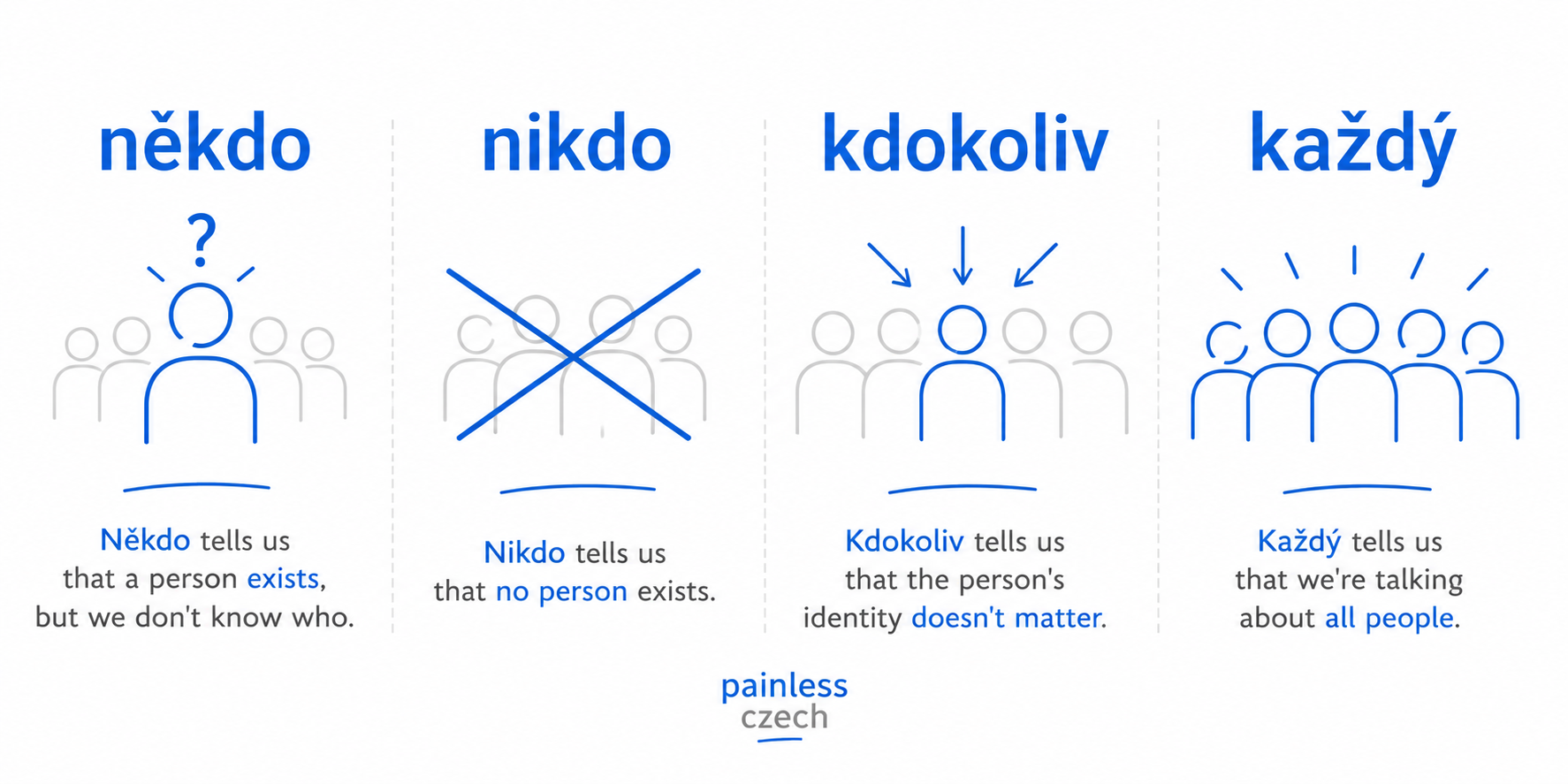
Four tiny Czech words. Four completely different meanings.
Once you start noticing these differences in everyday Czech, you'll hear them everywhere… in conversations, films, podcasts, and books. And after a while, you'll stop translating them from English altogether. You'll simply know which one sounds right.
Want to Learn Czech Without the Confusion?
The smallest Czech words often cause the biggest headaches. If you'd like to master Czech grammar with simple explanations, real-life examples, and practical tips that actually make sense, you're in the right place.
And if Czech pronouns still make you stop and think, my Czech Pronouns Cheat Sheet is here to help. It covers personal, possessive, demonstrative, interrogative, relative, indefinite, negative, and reflexive pronouns with clear explanations, easy-to-read declension tables, and plenty of real-life examples all in one clean, student-friendly guide.
Whether you're wondering when to use někdo, kdokoliv, nikdo, každý, or struggling with other Czech pronouns, this cheat sheet will help you choose the right one with confidence. Because Czech doesn't have to be painful.

Master Czech pronouns with this clear, student-friendly guide. The cheat sheet shows you how to use personal, possessive, demonstrative, interrogative, relative, indefinite, negative, and reflexive pronouns, all with simple explanations, declension tables, and real-life examples. It’s your survival kit for tricky Czech grammar, presented in a clean and easy layout.
