Czech Negation: Why One “No” Is Never Enough
English has a very strict rule about negation: Only one negative per sentence.
If you say something like: "I didn’t see nobody."
Your English teacher will appear out of nowhere, armed with a red pen and mild disappointment. But Czech looks at that rule and calmly says: That’s adorable.
Because in Czech, negatives multiply.
Two negatives? Perfectly normal.
Three negatives? Still fine.
Four negatives? Congratulations, you’re speaking very Czech.
Let’s explore how negation actually works in Czech and why English speakers constantly get it wrong.
Step One: Negation Is Built Into the Verb
The basic Czech negative is formed with the prefix ne- attached directly to the verb. That’s it. No helper verbs. No grammatical gymnastics.
Positive:
Hledám tužku.
"I am looking for a pencil."
Negative:
Nehledám tužku.
"I am not looking for a pencil."
Another example:
Bydlím v Praze.
"I live in Prague."
Nebydlím v Praze.
"I don’t live in Prague."
Notice something important: Czech does not need an equivalent of English do.
English says:
"I do not live in Prague."
Czech simply says:
"I not-live in Prague."
Much simpler.
Personal Pronouns Often Disappear
Czech verbs already contain information about the subject, so personal pronouns are often dropped.
You can say:
Já hledám tužku.
"I am looking for a pencil."
But in normal speech, Czechs usually say:
Hledám tužku.
The same works in negative sentences:
Nehledám tužku.
"I am not looking for a pencil."
The verb already tells us who is doing the action.
Czech grammar is efficient like that.
Now Comes the Weird Part for English Speakers
In English, negatives cancel each other. Two negatives create a positive.
Example:
"I didn’t see nobody."
Logically this means:
"I saw somebody."
That’s why English grammar insists on: "I didn’t see anybody."
But Czech refuses this logic completely.
In Czech, negative words must combine with a negative verb. Which means you get double negation as the normal structure.
Example:
Já jsem tam nikoho neviděl.
"I didn’t see anybody there."
Let’s look closely.
nikoho = nobody
neviděl = did not see
So literally the Czech sentence says:
"I nobody didn’t see there."
Which sounds chaotic in English. But in Czech it is perfectly correct.
Negative Words Always Trigger a Negative Verb
Czech has a whole family of negative words. Here are some of the most common ones:
nikdo – nobody
nic – nothing
nikdy – never
nikde – nowhere
nikam – nowhere (movement)
žádný – no / none
And these words must be used with a negative verb.
For example:
Nikdo není dokonalý.
"Nobody is perfect."
Nic se nestalo.
"Nothing happened."
Nikdy jsem nebyl v Austrálii.
"I have never been to Australia."
Nikde není taxi.
"There is no taxi anywhere."
Each sentence contains multiple negatives, and that is exactly how Czech grammar wants it.
Triple Negation (Yes, Really)
Once learners understand double negation, they assume it stops there. Czech politely disagrees.
Example:
Já nikam nepůjdu.
"I will not go anywhere."
Let’s break it down:
nikam = nowhere
nepůjdu = I will not go
Literal translation:
"I nowhere will-not-go."
Still perfectly normal Czech.
Another example:
Já jsem nikdy nikde nic neudělal.
"I have never done anything anywhere."
Czech sentence:
nikdy = never
nikde = nowhere
nic = nothing
neudělal = did not do
Four negatives. Zero problems.
Why English Speakers Keep Making This Mistake
English learners instinctively try to translate sentences like this:
"I didn’t see anyone."
So they produce:
Neviděl jsem někdo.
Which is wrong. Why? Because někdo means somebody, not nobody. Correct Czech must keep everything negative:
Neviděl jsem nikoho.
"I didn’t see anybody."
The rule is simple but unfamiliar: If the verb is negative, the pronouns must be negative too.
A Simple Rule to Remember Forever
If the verb has ne-, everything else should also be negative. Think of Czech negation like a team sport. One negative shows up. The others immediately join.
Examples:
Nic nevím.
"I know nothing."
Nikdo nepřišel.
"Nobody came."
Nikdy tam nechodím.
"I never go there."
If only one negative appears, Czech grammar feels unfinished. It wants company.
The Most Czech Sentence Possible
Let’s finish with a masterpiece of Czech negation: Já jsem nikdy nikde nikoho neviděl.
"I have never seen anyone anywhere."
Four negatives. Perfect grammar. And proof that in Czech, when it comes to saying no, one is simply not enough.
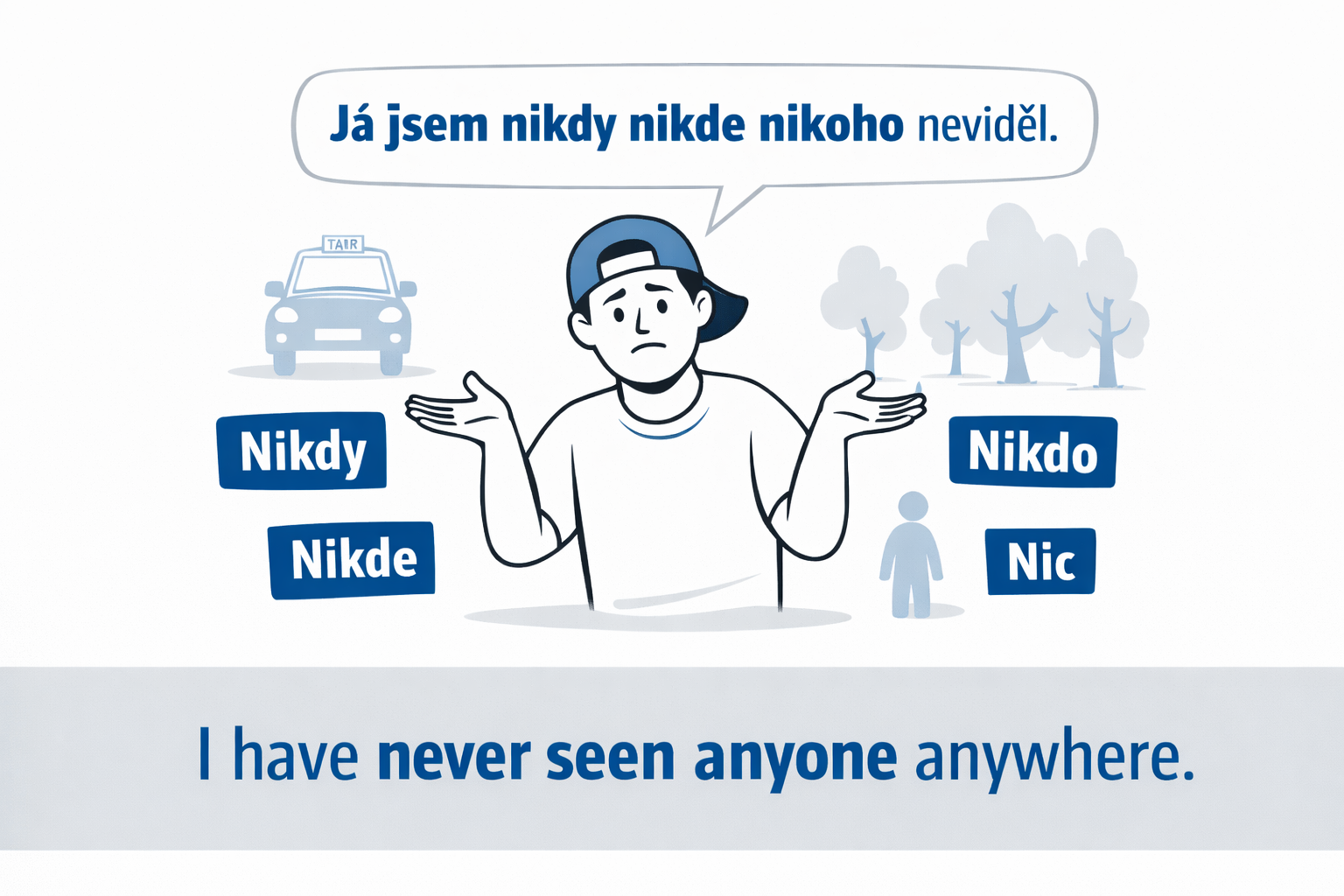
One simple negation in Czech is simply not enough!

The ultimate Czech Verbs Survival Kit – everything you need to master Czech verbs in one place. Learn how verbs work, how to form negatives, understand word order, master past and future tenses, verbs of motion, irregular and modal verbs, and reflexives. Clear explanations, patterns, and practical examples make Czech verbs finally click.
