How to Pronounce the Czech Ž Without Sounding Like a Broken Washing Machine
There are many ways to make a Czech person immediately realise you are learning Czech. You can say dobrý den with the confidence of someone who has absolutely no idea what comes next. You can spend three full seconds deciding whether č is supposed to be pronounced like ch or something else. Or you can encounter the letter ž and suddenly discover that your tongue has resigned from its position.
If you have ever looked at ž and thought, “Okay, but what exactly am I supposed to do with my mouth here?”, you are in the right place. The good news: ž is not nearly as terrifying as Czech makes it look.
So, what exactly is Czech Ž?
The Czech ž represents a voiced postalveolar fricative. That sounds impressively complicated, but you probably already know how to make the sound.
It is essentially the “zh” sound you hear in English words such as measure, vision, or usual. The important difference is that Czech treats ž as a proper letter, not a two-letter combination.
So: ž = one sound, one letter.
And yes, Czech has decided that one tiny letter deserves an entire pronunciation crisis.
Step 1: Start with “sh”
The easiest way to find the Czech ž is to begin with the English sh sound.
Say: shhhhh
Like you are telling someone to be quiet in a library. Now keep your tongue in roughly the same position, but switch your vocal cords on. That is the trick.
sh → ž
The difference is voicing.
With š, your vocal cords are not vibrating.
With ž, they are.
Try putting your fingers lightly against your throat while making the sound.
With š, you should feel mostly air.
With ž, you should feel a gentle vibration.
Congratulations. Your throat has just joined the lesson.
Step 2: Don't turn Ž into Z
This is one of the most common mistakes. Czech ž is not the same as z.
Compare:
z — the sound in zoo
ž — the sound in English measure
Your tongue is doing something quite different.
For z, the tongue is closer to the position used for s.
For ž, the tongue moves farther back, towards the area just behind the alveolar ridge.
If your Czech ž sounds suspiciously like z, your tongue has probably taken the wrong exit.
Step 3: Don't add a mysterious “y” sound
English speakers sometimes try to approximate Czech ž with something like “zhy” or “zhee”. Don't. There is no extra vowel hiding inside the consonant.
ž is a consonant. You should be able to hold the sound: žžžžžžž without immediately attaching a vowel to it. If you can do that, you are already much closer.
Step 4: Feel the vibration
Here is a useful little experiment. Put your hand on your throat.
Now alternate:
ššššš — žžžžž
You should feel the difference. Both sounds are produced with the tongue in a very similar position. The crucial difference is that ž is voiced.
This is also why Czech learners often find ž easier once they stop thinking about it as some exotic Czech sound. It isn't exotic. Your mouth already knows it. Your brain is just being dramatic.
Czech words with Ž
Now let's put the sound into actual Czech.
Žena
žena = woman
The initial ž is exactly the sound you are practising.
Žlutý
žlutý = yellow
This one is particularly useful because Czech gives you another challenge immediately afterwards. You have to survive žl. Because apparently one consonant wasn't enough.
Žít
žít = to live
Notice that the vowel after ž does not change the consonant itself.
Žába
žába = frog
A very useful word if you ever need to discuss frogs in Czech. Or if your Czech conversation has taken a particularly unexpected turn.
Muž
muž = man
Here the ž comes at the end of the word. That is worth practising because final voiced consonants can behave differently from what you might expect from spelling. In normal Czech pronunciation, final ž is pronounced devoiced, so muž ends with a sound closer to š.
And this is an important Czech pronunciation rule: Spelling says ž. Pronunciation says š. Czech has entered the chat.
The Ž–Š connection
If you struggle with ž, practise š first. These two sounds are very closely related. Think of them as the same basic tongue position with one major difference:
š = voiceless
ž = voiced
This relationship is extremely useful because Czech has both sounds:
šálek — cup
žlábek — groove
Try switching between: š — ž — š — ž — š — ž
Keep the tongue position stable. Only turn the voicing on and off. That is much easier than trying to invent ž from scratch.
A five-minute Ž workout
If you want to train your mouth rather than merely read about it, try this sequence.
1. Hold the sound
žžžžžžž
Keep it steady for a few seconds.
2. Alternate voicing
ššš — žžž — ššš — žžž
Focus on the vibration.
3. Add vowels
ža – že – ži – žo – žu
Don't rush. The goal is a clean consonant followed by a clean vowel.
4. Move Ž around the word
Practise:
žena
muž
žlutý
žít
kožich
5. Put it into a sentence
For example: Ta žena žije v Praze.
Now you are no longer practising a sound in isolation. You are making your tongue work for its Czech citizenship.
The most common Ž mistakes
“I pronounce Ž like Z.”
Move your tongue farther back and think of English measure rather than zoo.
“I pronounce Ž like Š.”
Turn your voice on.
Touch your throat and check for vibration.
“I say ZH as two separate sounds.”
Don't think z + h.
Think of one single consonant.
“I can pronounce Ž alone, but it falls apart in words.”
Completely normal. Move from isolated practice to syllables, then words, then sentences. Your mouth needs repetition, not another 47 grammar explanations.
One final trick
If you already speak English, find the word measure. Say the middle consonant very slowly. That sound is essentially the same type of sound you need for Czech ž.
Now keep that sound and practise it in Czech words. You don't need to build a brand-new sound from nothing. You just need to teach your existing pronunciation system that Czech has decided to give this sound its own letter.
And honestly, that's one of the nicer things Czech does. For once.
Ready to make Czech less painful?
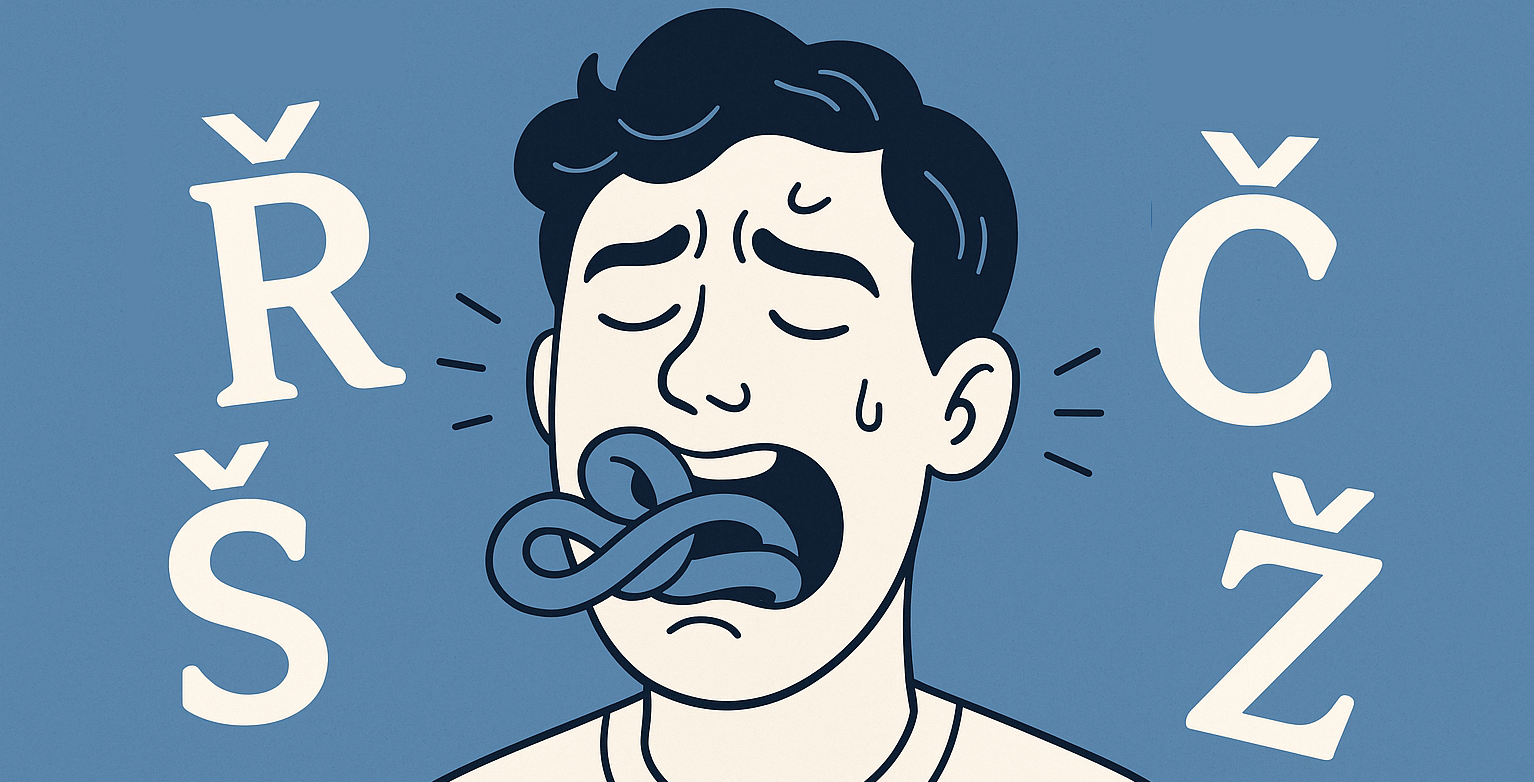
If ž, š, č, ř and the rest of the Czech pronunciation circus still make your tongue question its career choices, my course Czech Your Tongue will help you work through the sounds step by step, with practical pronunciation practice rather than endless theoretical explanations.
Your Czech doesn't need to sound perfect. It just needs to become easier to understand and easier for you to say.
