Why Czechs Say Dobrej and Dobrý: The Czech Colloquial Adjective Endings You’ll Hear Everywhere
You’ve learned that the Czech word for “good” is dobrý. Excellent. Very useful word. You can use it in dobrý den, dobrý film, dobré jídlo, dobrá káva…
And then you meet an actual Czech person. They say:
Dobrej film.
You pause. You check your vocabulary. You check your grammar. You briefly wonder whether dobrej is a completely different word. It isn’t. Welcome to one of the most useful features of everyday spoken Czech: colloquial adjective endings.
If you spend any time listening to Czechs talking to each other, you will very quickly notice that the textbook ending -ý often becomes -ej in the masculine singular:
dobrý → dobrej
malý → malej
velký → velkej
nový → novej
And there is another little surprise waiting for you:
The standard ending -é in the neuter singular often sounds like -ý:
dobré → dobrý
malé → malý
velké → velký
nové → nový
So suddenly Czech has apparently decided that ý, ej, and é are all going to participate in the same conversation. But there is actually a very clear pattern behind it.
First: the basic pattern
In standard written Czech, you have:
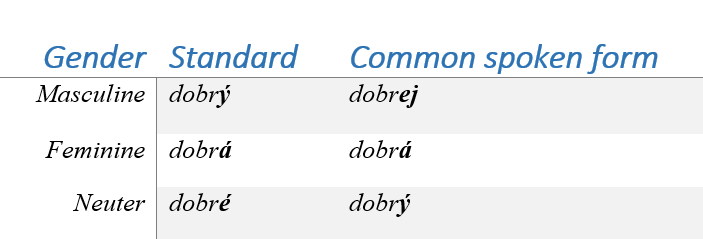
Yep. The feminine form behaves…
So:
To je dobrej film.
"That's a good film."
To je dobrá restaurace.
"That's a good restaurant."
To je dobrý víno.
"That's good wine."
Notice what happened with víno.
The standard form is:
To je dobré víno.
But in everyday speech, you will very commonly hear:
To je dobrý víno.
This is not a mistake in the sense of someone accidentally using the wrong grammar. It is a colloquial pronunciation/form that is extremely common in spoken Czech. And once you start noticing it, you will hear it everywhere.
Masculine -ý becomes -ej
Let's start with the easiest one. When a masculine adjective ends in -ý in the standard form, the spoken form very often changes -ý to -ej.
So:
dobrý → dobrej
nový → novej
starý → starej
malý → malej
velký → velkej
hezký → hezkej
český → českej
anglický → anglickej
Compare:
To je dobrý film.
"That's a good film."
In everyday speech:
To je dobrej film.
"That's a good film."
Or:
To je novej seriál.
"That's a new series."
To je nějakej divnej člověk.
"That's some weird guy."
Máme hezkej byt.
"We have a nice apartment."
To je českej film.
"That's a Czech film."
You will hear this constantly in informal conversations.
And yes, dobrej is the form you are likely to hear from your Czech friend, your colleague at the pub, the person behind the counter, or someone telling you about a film they watched last night.
What is happening here?
You might reasonably ask: Why does Czech do this? The short answer is: because spoken language and written language are not identical.
Every language has differences between its formal and informal varieties.
In English, you might say: "I am going to..." but in everyday speech you are much more likely to hear: "I'm gonna..."
Or: "Do you want to..." becomes: "D'you wanna..."
Nobody thinks English has stopped having grammar. Speech simply has its own patterns. Czech is the same.
The forms dobrej, novej, malej etc. are part of colloquial Czech (hovorová čeština). They are especially common in relaxed, informal speech.
So when you hear: To je dobrej nápad. the speaker isn't necessarily being careless. They are speaking naturally.
And then there is neuter -é → -ý
This is where Czech learners often get suspicious.
You learned:
dobré jídlo
"good food"
And then someone says:
Dobrý jídlo.
Excuse me?
Yes. In colloquial speech, the neuter singular ending -é is very often pronounced/realized as -ý.
So:
dobré → dobrý
malé → malý
velké → velký
nové → nový
hezké → hezký
For example:
To je dobrý jídlo.
"That's good food."
Máme nový auto.
"We have a new car."
To je malý město.
"That's a small town."
To je velký problém.
"That's a big problem."
Je to hezký místo.
"It's a nice place."
These forms are incredibly common in everyday speech. And this is one reason why listening to Czech can feel harder than reading Czech.
You may have learned:
To je dobré.
But your Czech friend says:
To je dobrý.
Your textbook says:
Je to velké.
Your colleague says:
Je to velký.
You learned:
To je nové auto.
Your friend says:
To je nový auto.
And suddenly you think:
"I definitely know Czech. Why does Czech not know itself?"
It does. You are simply hearing a different register.
The two changes side by side
Here is the pattern you want to remember:
Masculine
-ý → -ej
dobrý → dobrej
"good"
velký → velkej
"big"
malý → malej
"small"
nový → novej
"new"
starý → starej
"old"
Neuter
-é → -ý
dobré → dobrý
"good"
velké → velký
"big"
malé → malý
"small"
nové → nový
"new"
staré → starý
"old"
And feminine? Nothing changes:
dobrá → dobrá
"good"
nová → nová
"new"
velká → velká
"big"
malá → malá
"small"
So the feminine is sitting quietly in the corner while masculine and neuter are making things complicated.
You will hear this especially in very ordinary sentences
This isn't some strange linguistic curiosity that only appears in grammar books. It appears in extremely ordinary Czech.
Imagine your Czech friend showing you their new apartment:
Máme novej byt.
"We have a new apartment."
You say you like the apartment.
Je to fakt hezkej byt.
"It's a really nice apartment."
Your friend agrees:
Jo, je to dobrý místo.
"Yeah, it's a good place."
Notice how naturally these forms appear.
Dobrej is not the same thing as “incorrect”
This is important. As a Czech learner, you will probably encounter two completely different situations.
Situation 1: You are writing
You are writing an email to your university professor.
You write:
Dobrej den, pane profesore.
Probably not the best idea.
Use:
Dobrý den, pane profesore.
"Good afternoon, Professor."
Situation 2: You are talking to your friend
Your friend asks:
Jaký to bylo?
"How was it?"
You say:
Byl to dobrej film.
"It was a good film."
That sounds perfectly natural in informal conversation. The key isn't simply correct vs. incorrect. The better question is: What kind of situation am I in?
When should you use the colloquial forms?
Think about register.
Colloquial endings are especially natural in:
conversations with friends
casual conversations with colleagues
informal social situations
everyday spoken Czech
relaxed conversations
dialogue in films and TV shows
For example:
To byl dobrej večer.
"That was a good evening."
To je nějakej divnej týpek.
"That's some weird guy."
Máme novej problém.
"We have a new problem."
To je fakt dobrej nápad.
"That's a really good idea."
To je dobrý.
"That's good."
These are exactly the kinds of forms you want to recognize when listening to Czech.
But don't throw -ej into every sentence immediately
Here is the slightly annoying part. Just because Czechs use dobrej all the time doesn't mean you need to start replacing every -ý with -ej immediately.
As a learner, the most important thing at first is to understand the forms when you hear them.
If you say:
To je dobrý film.
you will be understood perfectly.
If you say:
To je dobrej film.
you sound more colloquial.
Both can work. The difference is mainly about style and register. And if you're still learning Czech, using the standard forms gives you a very solid foundation. Once you become comfortable with spoken Czech, you can start using the colloquial forms naturally too.
One very useful expression: Dobrý!
There is one form you will hear constantly: Dobrý!
Depending on context, it can mean:
"Good!"
"Okay!"
"Great!"
"Fine!"
For example:
Tak v šest?
"So, at six?"
Dobrý.
"Okay."
Or:
Tak jo, máme to hotový.
"Alright, we're done."
Dobrý!
"Great!"
You will also hear:
To je dobrý.
"That's good."
But context matters enormously.
For example:
To není dobrý.
"That's not good."
This might mean that something is genuinely bad.
Or:
Dobrý, dobrý...
can mean something closer to:
"Okay, okay..."
Czech intonation does a lot of work.
Watch out for -ý after -j
There is another reason listening to these endings can be confusing. Words ending in -ej are not necessarily simply “the colloquial version of -ý” in every context.
For example:
moje
"my"
is not simply a colloquial version of some imaginary mojý.
So don't create a rule that says: "Whenever I see a Czech adjective, I should change the ending to -ej." Absolutely not.
The pattern we're talking about here is specifically the common colloquial realization of adjective endings in particular forms.
In other words:
dobrý → dobrej
is useful.
But: "everything with -ý becomes -ej everywhere" is not a rule you should apply blindly. Czech grammar has already given you enough homework. You don't need to invent extra homework for yourself.
Listen for the pattern instead of trying to decode every word
This is probably the most useful advice for your Czech listening.
If you hear: To byl fakt dobrej film. don't stop and think:
"What is dobrej? Is this a new adjective? Is it a noun? Is Czech attacking me?"
Your brain should gradually learn:
dobrej = dobrý
So:
Dobrej film.
"A good film."
becomes just as recognizable as:
Dobrý film.
"A good film."
The same goes for:
novej = nový
"new"
malej = malý
"small"
velkej = velký
"big"
českej = český
"Czech"
anglickej = anglický
"English"
This is one of those moments when improving your Czech is less about learning more vocabulary and more about learning to recognize the vocabulary you already know in its natural spoken form.
A mini real-life conversation
Let's put everything together. Imagine two friends talking about a restaurant:
Tak co, jaká byla ta nová restaurace?
"So, how was that new restaurant?"
Fakt dobrá. Měli tam skvělý jídlo.
"Really good. They had great food there."
Jo? A byl tam dobrej výběr?
"Really? And was there a good selection?"
Jo, a měli i dobrý pivo.
"Yeah, and they even had good beer."
Tak tam někdy zajdeme.
"Then let's go there sometime."
Notice the mixture. Real Czech speakers don't necessarily use one single “mode” where every ending is either completely standard or completely colloquial.
You may hear different forms depending on the speaker, the phrase, the rhythm of the sentence, and the level of formality. That's normal.
What should YOU actually say?
Here's a simple strategy.
If you're writing:
Stick to the standard forms.
Dobrý den.
"Good day / Hello."
To je dobrý film.
"That's a good film."
Máme nové auto.
"We have a new car."
To je dobré jídlo.
"That's good food."
If you're speaking casually:
You can gradually introduce colloquial forms.
Dobrej film.
"A good film."
Novej byt.
"A new apartment."
Dobrý jídlo.
"Good food."
Je to fakt dobrej nápad.
"It's a really good idea."
But don't feel that you have to sound like a Czech from day one. There is absolutely nothing wrong with speaking clearly and using standard endings. In fact, as a learner, recognizing colloquial Czech is often more important than producing it immediately.
The cheat sheet
If you remember only one thing from this article, remember this:
Masculine singular:
-ý → -ej
dobrý → dobrej
nový → novej
velký → velkej
malý → malej
Neuter singular:
-é → -ý
dobré → dobrý
nové → nový
velké → velký
malé → malý
Feminine:
No change.
dobrá → dobrá
nová → nová
velká → velká
And the most important lesson: Don't panic when you hear dobrej instead of dobrý.
You already know the word. Czech is simply wearing its everyday clothes. And once you start hearing dobrej, novej, velkej and dobrý jídlo without stopping to translate them in your head, you'll notice something important: You haven't just learned another grammar rule. You've started understanding real Czech.
Want Czech Adjective Endings to Finally Make Sense?
Czech adjective endings can feel like a never-ending game of “Which ending am I supposed to use this time?” If you want all the essential Czech adjective patterns in one clear place (including masculine, feminine, neuter, cases, endings, and useful examples) I made a cheat sheet for exactly that.

If you’ve ever wondered why malý pivo or křupavý kuře sound natural to locals, this sheet is for you! Czech adjectives are true shapeshifters — they change depending on gender, number, and case. But don’t panic: this guide makes it easy (and funny).
You’ll learn:
The two main families: hard vs. soft adjectives.
Singular & plural forms you’ll say every day.
How to compare adjectives (bigger → biggest).
Real Czech: how malé pivo becomes malý pivo and nový turns into novej.
A full reference table for gender & number.
