How to Practice Czech Conversation Skills (Even If You Don’t Live in Czechia)
You can understand Czech grammar. You know quite a lot of vocabulary. You can decline a noun without immediately questioning all your life choices. And then a Czech person looks at you and says: Tak co, jak se máš?
Your brain: I know every single one of these words.
Your mouth: Ehm… ano.
Yes. You have just discovered one of the great mysteries of language learning: Knowing Czech and actually speaking Czech are two different skills.
The good news? You don't need to move to Prague, marry a Czech person, or spend 14 hours a day chatting in a hospoda to improve your conversation skills. You need to practice producing Czech regularly in small, manageable ways. And preferably without making every conversation feel like an oral exam.
Why Is Speaking Czech So Much Harder Than Understanding It?
Because speaking is the moment when Czech leaves your brain and has to make it all the way to your mouth. Reading gives you time. Listening lets someone else do the work. Speaking? No rewind button. No subtitles. No ten-minute pause while you desperately search for the correct instrumental plural of something. You have to respond in real time.
And conversation isn't only grammar. It's also rhythm, tone, hesitation, reactions, body language, fillers, shortcuts and all those tiny expressions that textbooks somehow forget to mention.
Real Czech conversation is gloriously messy. You might start a sentence, change your mind halfway through, forget a word, describe it with your hands and eventually arrive somewhere completely different from where you intended.
That's not failure. That's conversation.
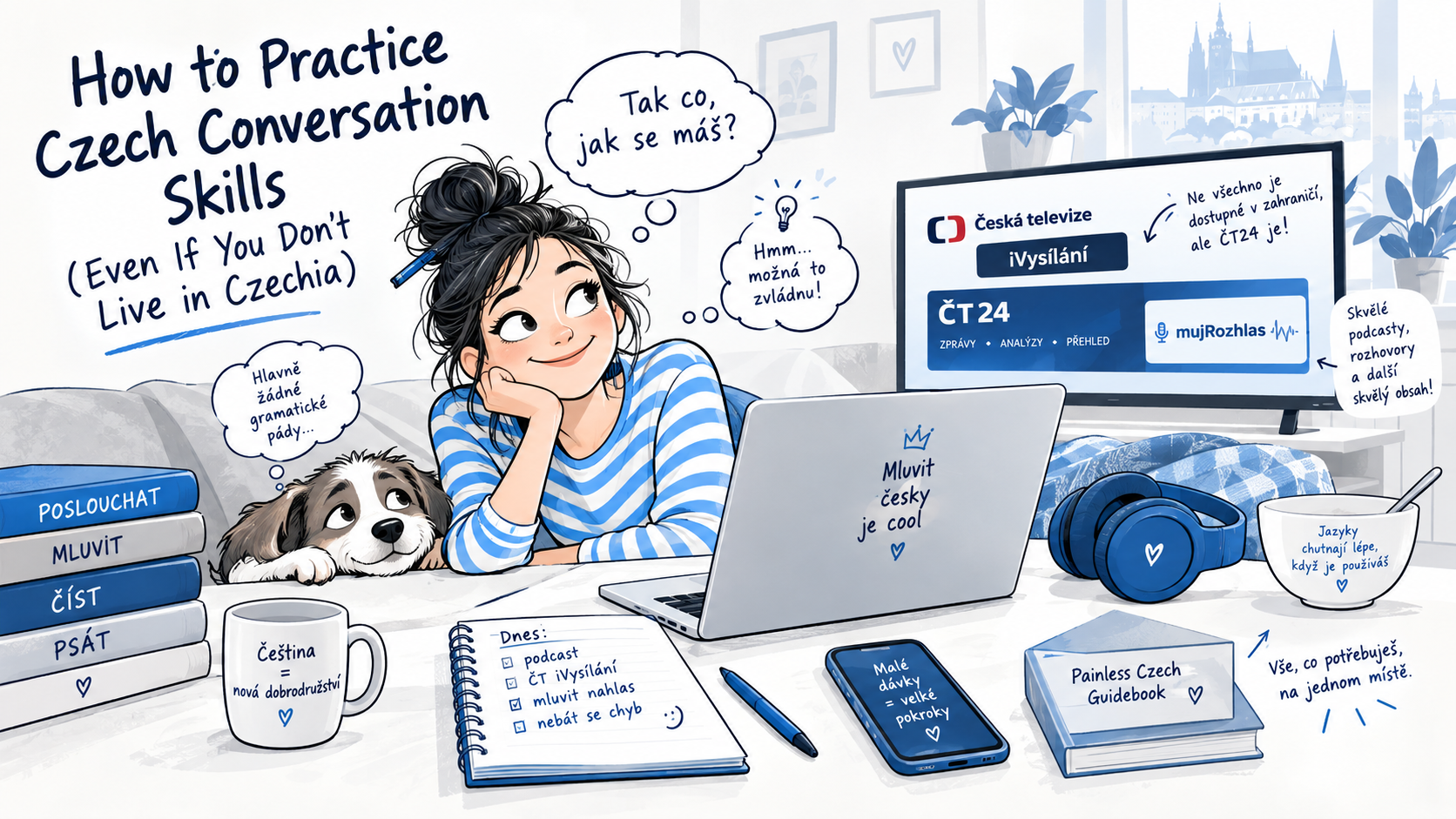
Czech conversation skills: because knowing 500 words doesn’t mean you know what to say.
Stop Waiting Until You're "Ready"
This is probably the biggest trap. You tell yourself: "I'll start speaking when I know more vocabulary." Then you learn more vocabulary. "I'll start speaking when I understand the cases." You learn the cases. "I'll start speaking when I can make more complicated sentences." And suddenly you've been learning Czech for three years and can explain the entire Czech declension system...
…but still point at the menu when you want lunch.
Speaking practice is how you become ready to speak. You don't need perfect Czech to start. In fact, waiting for perfect Czech is a very efficient way to avoid speaking Czech forever.
The goal isn't: "Say everything correctly."
The goal is: "Get the message across."
If you forget the word umbrella, describe it. To je… věc, když prší… If you forget opravit, explain what you mean. If you don't know the ending, keep going. Gesture. Point. Rephrase. Laugh. Communication is the point.
Talk to Yourself
Yes.
I'm serious.
Your first Czech conversation partner can be you.
And the wonderful thing about this conversation partner is that they are available 24/7, don't charge by the hour and can't correct your pronunciation every twelve seconds.
Switch part of your inner monologue into Czech.
In the morning: Dobré ráno. Dneska musím pracovat.
While making coffee: Dělám si kafe. Nemám mléko. Samozřejmě.
On your way to work: Dneska je zima. Autobus má zase zpoždění.
At the supermarket: Potřebuju koupit mléko, chleba a něco k večeři.
Suddenly, ordinary life becomes a Czech lesson. And it has another advantage: you discover exactly what you can't say.
That's incredibly useful. You think you know the word for something until you actually need to say it.
Then your brain goes: Excellent question. I have absolutely no idea.
Write that word down. Look it up later. Now you have learned vocabulary that is connected to your actual life, rather than a random vocabulary list.
Become Your Own Czech Tour Guide
You don't have to wait until you're in Prague. Describe what you see.
Walking down the street? Tady je kavárna. Je tam hodně lidí.
See a dog? Ten pes je obrovský! Co asi dělá?
Waiting for a bus? Jedu číslem šestnáct. Doufám, že nebude mít zpoždění.
Cooking dinner? Teď krájím cibuli. Potom přidám rajčata.
It may feel ridiculous. Good. Ridiculous is often more useful than silent.
And don't just describe things. Ask yourself questions and answer them.
Co budu dnes dělat?
Budu pracovat a večer půjdu do kina.
Co jsem dělal včera?
Včera jsem byl doma.
Co bych chtěl dělat o víkendu?
Chtěl bych jet někam na výlet.
You're quietly rehearsing the kinds of structures you'll need in real conversations.
Use Voice Memos
Here's an easy upgrade. Open the voice recorder on your phone. Set a timer for one minute. Talk. That's it.
You can talk about:
what you did today
what you're going to do tomorrow
your weekend
your job
your family
something you watched
something that annoyed you
what you had for dinner
why Czech cases are personally attacking you
Don't stop every three seconds to check grammar. Just keep talking. Then save the recording. After a week, listen to one of your old recordings.
You'll probably notice things you didn't notice while speaking:
the same filler words appearing repeatedly
sentences you always start but never finish
vocabulary gaps
pronunciation problems
rendings you consistently get wrong
Recording yourself gives you something concrete to notice over time instead of relying on the vague feeling of "I think I'm getting better?" And yes, listening to your own voice in another language is slightly horrifying. That's normal.
Try Shadowing
Shadowing sounds very scientific. It is actually just copying someone. Find a short piece of Czech audio. Listen to one sentence.
Then repeat it out loud, trying to copy:
pronunciation
rhythm
intonation
pauses
speed
You can use a podcast, video, interview or even a Czech song.
For example:
Listen.
Pause.
Repeat.
Listen again.
Repeat again.
Try saying it along with the speaker.
You're not just learning vocabulary. You're training your mouth to produce Czech in chunks. This matters because native speakers don't construct every sentence word-by-word from a giant grammar spreadsheet. They use familiar patterns. The more Czech you hear and repeat, the more of those patterns become available when you need them.
Don't Just Listen. Turn Listening into Speaking
This is where many learners get stuck. They listen to podcasts. They watch Czech videos. They understand more and more. Excellent!
But then a Czech person asks them a question and… Loading Czech… So when you listen, occasionally stop and react.
Imagine someone says: Včera jsem byl v Brně.
Don't just understand it. Answer. Fakt? Co jsi tam dělal?
Or imagine someone says: O víkendu pojedu na hory.
You could respond: Kam přesně?
Or: To zní dobře! Já bych taky chtěl jet.
You're turning passive listening into active conversation.
Find Real Czech Voices
Eventually, you need to talk to actual humans. Fortunately, you don't necessarily need to move to Czechia. And yes, you can listen while walking, cooking or pretending to clean your apartment. I won't ask questions.
Český rozhlas / mujRozhlas
mujRozhlas is a fantastic resource once you're ready for more authentic Czech. You'll find podcasts, interviews, radio programmes, documentaries, stories and much more. The platform brings together the programmes and broadcasts of Český rozhlas in one place. You can start with shorter programmes and gradually move towards longer interviews.
One fun option is Okolo češtiny, which has short episodes about interesting features and traps of the Czech language. Episodes are only a few minutes long, which makes them much less intimidating than opening a 90-minute Czech podcast and immediately questioning your life choices.
Česká televize / iVysílání
And then there's Česká televize.
iVysílání is the online archive of Česká televize, with Czech series, films, documentaries, interviews, news, travel programmes and much more.
For Czech learners, it's a goldmine of authentic listening material. You can watch a comedy, listen to an interview, follow a documentary or simply put on a Czech programme in the background while doing something else.
There is one important catch if you're outside Czechia: not everything on iVysílání is available internationally. Some programmes are geoblocked because of licensing restrictions. Česká televize says that news content from ČT24 is available abroad without these restrictions, while the availability of other programmes depends on the individual programme's rights.
So if you're outside Czechia, don't be surprised if you click on something and iVysílání politely tells you, essentially: Litujeme, ale tento pořad nelze mimo území ČR přehrát.
Instead, look for programmes that are available to you, and use ČT24 when you want reliable access to current Czech news and authentic spoken Czech.
For learners, shorter programmes can be especially useful. For example, Kalendárium offers roughly 14-minute episodes about historical events and Czech personalities, while Na cestě has around 25–30 minute episodes about places, culture and travel.
And if you're ready for a serious listening workout, iVysílání also has interviews, discussions and documentaries where you'll hear people speaking naturally rather than carefully producing "learner Czech." For example, Na dosah features discussions with experts and the public on different topics.
You don't have to understand every word. Actually, please don't try to understand every word. Choose a short section, listen once for the general idea, then listen again and pick out phrases you could actually use yourself. That's how passive listening slowly turns into active Czech.
Find a Conversation Partner — But Give Yourself a Job
"Find a Czech friend" sounds like wonderful advice. It's also not particularly helpful if you're sitting across from each other thinking: Tak… o čem budeme mluvit?
Instead, give the conversation a structure.
Choose one topic:
food
travel
childhood
work
movies
Czech traditions
embarrassing moments
your dream holiday
the worst job you've ever had
Prepare three questions beforehand.
For example, the topic is travel:
Kam nejraději cestuješ?
Jaká byla tvoje nejlepší dovolená?
Kam bys chtěl jet příště?
Now you have a starting point. You don't need to prepare a 45-minute speech. You just need enough material to get the conversation moving.
Try a Language Exchange
If you don't have a Czech-speaking friend, find someone who wants to practise English. You speak Czech together. Then you speak English together.
A simple 20 minutes Czech + 20 minutes English arrangement can work beautifully.
One option is Tandem, a language-exchange platform where you can connect with people learning each other's languages.
Just remember: A language exchange is not a Czech lesson. That's actually the point.
You want to experience what happens when you're trying to communicate without someone handing you the correct answer every five seconds.
Practice Real-Life Situations
One of the best ways to improve conversation is to practise conversations you will actually need.
Instead of: Můj medvěd má rád banány… which is admittedly a very important sentence for the bear community…
try:
Můžete mi prosím pomoct?
Kolik to stojí?
Chtěl bych si rezervovat stůl.
Nevím, jak se to řekne česky.
Můžete to zopakovat, prosím?
Co znamená…?
Jak se řekne…?
And then build from there.
Going to the doctor? Practise that vocabulary.
Calling the bank? Rehearse the conversation first.
Meeting your Czech partner's family? Prepare some questions.
Going to a restaurant? Practise ordering.
The closer the practice is to your real life, the easier it becomes to retrieve the language when you actually need it.
Learn How to Survive When You Forget a Word
This is an underrated conversation skill. Because you will forget words. Even advanced speakers forget words. The difference is that experienced speakers know what to do next. Instead of freezing, try explaining the missing word.
For example, you forget umbrella: Je to věc, kterou používáš, když prší.
You forget kettle: Je to něco, v čem vařím vodu na čaj.
You don't know the Czech word for "receipt": Můžu dostat ten papír z pokladny?
This is a hugely important skill: Don't make communication dependent on knowing every word.
Learn to go around the missing word. Your brain will get much better at finding alternative routes. And sometimes the Czech word you were desperately trying to remember will suddenly appear five minutes later. Because apparently the brain enjoys dramatic entrances.
Make Mistakes on Purpose
Not wrong on purpose. But create situations where mistakes are allowed.
Tell your conversation partner: "Please don't correct every single mistake. Let me finish my thought first."
If you're constantly interrupted:
Já… "Correction."
Včera… "Correction."
Byl jsem… "Correction."
…you're not having a conversation.
You're taking a very stressful grammar quiz. Sometimes it's useful to focus on fluency first and corrections later. You can even keep a list called:
"Things I Wanted to Say but Couldn't"
Every time you get stuck, write down the missing word or phrase. Later, look it up. Then use it in three new sentences. This turns a frustrating moment into useful learning material.
Five Minutes Beats One Heroic Weekend
You don't need a two-hour "Czech speaking session" every day. In fact, you may be much better off with tiny amounts of speaking scattered throughout your day.
Try:
Morning — 2 minutes Talk about your plans.
Lunch — 3 minutes Describe what you're eating.
Commute — 5 minutes Narrate what you see.
Evening — 1 minute Record a voice memo about your day.
That's already 11 minutes of speaking practice. And unlike a giant study session, this is something you might actually continue doing.
The philosophy behind Painless Czech is simple: you don't necessarily need to study harder; you need to make Czech part of your life in ways you can sustain. Five relaxed minutes every day can be much more useful than one heroic three-hour session followed by six days of guilt.
A Simple Weekly Czech Speaking Challenge
Want something concrete?
Try this for one week.
Monday
Talk to yourself in Czech for 5 minutes.
Tuesday
Record a one-minute voice memo.
Wednesday
Watch a short Czech video and shadow 5 sentences.
Thursday
Have a 10–20 minute conversation with a Czech speaker or language partner.
Friday
Describe your day entirely in Czech.
Saturday
Pick one real-life situation and role-play it.
Sunday
Listen to your Monday voice memo.
Notice what has changed.
Then do it again.
Not because you need another perfect study plan.
Because repetition is what turns "I know this" into "I can actually use this."
The Most Important Conversation Skill? Keep Going.
You will forget words. You will use the wrong case. You will say something that sounded perfectly normal in your head and slightly bizarre once it escaped your mouth. You will occasionally produce a Czech sentence that makes absolutely no grammatical sense. Keep going.
Speaking isn't a performance where you have to prove that you know Czech. It's a skill you build by using Czech before you're completely ready. Every imperfect sentence gives your brain another chance to figure out what it needs next.
And every time you successfully communicate something… even something very simple… you're teaching your brain: Hey. We can do this. That's how Czech starts becoming something you use, not just something you study.
Want More Ways to Make Czech Part of Your Everyday Life?
If you're tired of collecting Czech grammar rules and vocabulary lists but still wondering "Okay… but how do I actually use this?", that's exactly why I created the Painless Czech Guidebook.
Forget the grammar drills. Learn Czech the way your brain actually likes.
This no-fluff, habit-based guide shows you how to make Czech part of your life without burning out.
Inside, you’ll find:
✔ Smart study routines you can actually stick with
✔ Speaking, listening, reading & writing tips that fit into your day
✔ Real examples, real phrases, real Czech
✔ Media and tech tools to plug into Czech daily
Whether you're a fresh beginner or somewhere mid-journey, this guide gives you a smarter way in. No exercises, no guilt. Just a flexible roadmap built for real people and real lives.
It's a practical, no-fluff guide to making Czech part of your everyday life — without turning your life into one giant language course.
Inside you'll find:
practical routines for reading, listening, speaking and writing
ideas for practising Czech in tiny daily doses
real Czech media, podcasts, websites and tools
strategies for speaking even when you don't feel ready
ideas for using Czech during your morning, commute, cooking, scrolling and downtime
Czech-specific resources that are actually useful
50 pages of practical strategies and Czech-learning hacks
It's designed for real people with real lives… not people who have somehow found an extra four hours hidden behind their refrigerator.
And yes, there's an entire section on speaking and conversation, including real conversations, language exchanges, inner speech, narration, voice practice and ways to get Czech out of your head and into your mouth.
