Václav Havel: The Czech Man Who Went From Theatre to Prague Castle
Imagine being a playwright. You write strange plays about bureaucracy, language and absurd situations. You spend time in the theatre, sign petitions, annoy the communist government, and occasionally end up in prison. And then, somehow, you become president. That is basically the story of Václav Havel.
He was a playwright, essayist, dissident, political prisoner, one of the leading figures of the Velvet Revolution, the last president of Czechoslovakia and the first president of the Czech Republic. He was also, perhaps most importantly, someone who kept writing, thinking and asking uncomfortable questions even when it would have been much easier to shut up.
And in 2026, there is a particularly good reason to learn a little more about him: Havel would have turned 90 this year. So let's meet the man behind the famous glasses.
So, Who Was Václav Havel?
Václav Havel was born in Prague in 1936 into a prominent family connected with architecture, culture and business. He became interested in literature and theatre and eventually established himself as a playwright.
Then came communism.
Havel's criticism of the regime and his involvement in dissident activities made him increasingly unwelcome to the authorities. He became one of the important figures of the Czechoslovak dissident movement and a signatory of Charter 77, a human-rights initiative that challenged the communist government.
He was repeatedly imprisoned. And this is where his writing becomes particularly interesting. Havel wasn't just interested in politics. He was fascinated by language, power, responsibility and the absurdity of everyday life under an authoritarian system. Which is probably why his plays can still feel surprisingly modern.
From Dissident to President
Then came 1989. The communist regime collapsed during the Velvet Revolution, and suddenly the man who had been watched, arrested and imprisoned by the state became the person leading it.
Havel was elected president of Czechoslovakia on December 29, 1989. Yes, really. A playwright became president. And not just any playwright. A playwright who had spent years writing about the absurdity of bureaucratic power was now sitting in Prague Castle dealing with actual bureaucrats. You couldn't make this up. Well, actually, Havel probably could.
He remained president of Czechoslovakia until its dissolution in 1992 and then became the first president of the Czech Republic, serving from 1993 to 2003.
Why Do Czechs Still Talk About Him?
Because Havel wasn't simply a historical politician. His name is still connected with ideas that are very much part of Czech public life:
pravda — truth
svoboda — freedom
odpovědnost — responsibility
lidská práva — human rights
občanská společnost — civil society
naděje — hope
He also had an unusual ability to turn complicated political and philosophical ideas into memorable phrases.
One of the most famous is:
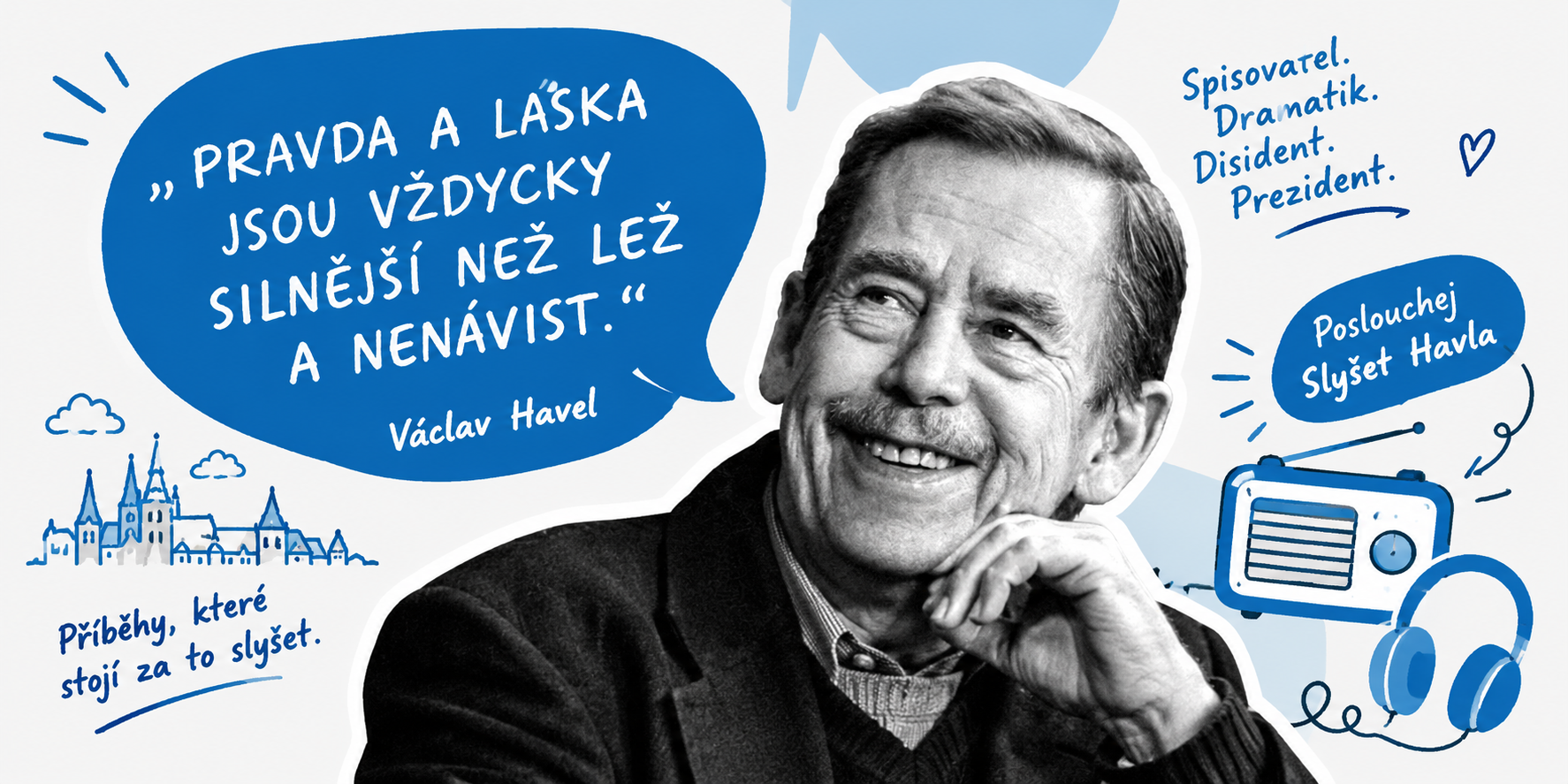
Pravda a láska musí zvítězit nad lží a nenávistí. "Truth and love must prevail over lies and hatred."
You don't need to agree with every political idea associated with Havel to understand why this sentence became so strongly connected with the period after 1989.
Start With His Writing: Moc bezmocných
If you want to understand Havel rather than simply memorise his biography, read Moc bezmocných (The Power of the Powerless).
Havel wrote the essay in 1978, and it became one of his most important political texts. It examines how authoritarian systems work and, importantly, what ordinary people can do when they live inside one.
The essay is not exactly a relaxing beach read. But it is worth reading because it gives you a much better idea of how Havel thought.
And there is an interesting bonus for Czech learners: you'll encounter a lot of vocabulary connected with politics, society, power and everyday life under communism.
If the original Czech feels too difficult, start with a translation and then return to selected passages in Czech. That's a much more painless way to approach a difficult text.
Watch Tady Havel, slyšíte mě?
If you want something you can watch now, I highly recommend the documentary Tady Havel, slyšíte mě? (Havel Speaking, Can You Hear Me?).
Director Petr Jančárek filmed Havel during the final years of his life, from 2009 to 2011. The documentary shows him not only as a former president but also as a husband, friend, filmmaker, patient and, occasionally, a rather tired human being. That's what makes it interesting.
You get to see Havel away from the official photographs and historical speeches. There are meetings with people such as Madeleine Albright, Miloš Forman and the Dalai Lama, but also much more personal moments and footage from Havel's home and Hrádeček.
And for Czech learners, there's another advantage: real Czech.
People speaking naturally. Different accents. Different speeds. Real conversations rather than textbook dialogue. That's practically a free listening exercise disguised as a documentary.
And Then: Slyšet Havla
If you prefer listening to watching, you absolutely need to check out Slyšet Havla on mujRozhlas.
The project brings together a whole collection of programmes connected with Havel's life and work. You can listen to his plays, interviews, archive recordings and discussions about his ideas.
And there is a particularly good reason to check it out right now. The current programme includes new recordings of Havel's plays, including Audience, Vyrozumění, Asanace and Pižďuchové. Some of the recordings are available for a limited period, so this isn't one of those links you want to bookmark and then forget about for three years.
If you're learning Czech, don't try to understand every single word.
Listen for:
words you recognise
expressions you hear repeatedly
intonation
pronunciation
the general meaning of a scene
And let the rest wash over you. That is listening practice too.
One More Documentary: Občan Havel
For a broader view of Havel as president, look for Občan Havel (Citizen Havel). This famous documentary followed Havel during his presidency and gives you something history books can't: ordinary moments, awkward moments, political moments and all the little things that happen when an actual human being has to function inside the machinery of a presidency.
It was directed by Pavel Koutecký and later completed by Miroslav Janek. Czech Television currently has four episodes available through iVysílání.
If Tady Havel, slyšíte mě? shows you Havel near the end of his life, Občan Havel gives you Havel inside the presidency. Together, they make a great pair.
Where Can You Find More Havel?
If you become slightly obsessed and honestly, that's very easy to do, don't just Google "Havel quotes" and trust the first inspirational Pinterest graphic you see. There are much better sources.
Czech Television
The Česká televize archive has a huge collection of programmes connected with Havel, including documentaries, interviews, historical programmes and educational materials. Its Havel page is a particularly good place to start.
Explore Václav Havel on Česká televize
Český rozhlas / mujRozhlas
The Český rozhlas archive is fantastic if you want historical audio. The Slyšet Havla project is essentially a rabbit hole of Czech listening practice.
Search for Havel on mujRozhlas
Václav Havel Library
For serious research, go straight to the source. The Václav Havel Library has a huge digital archive containing Havel's texts, photographs, videos, audio recordings, letters, bibliography and thousands of documents about him. The archive currently contains more than 88,000 processed records. The Library also has an English-language section, which is useful if you're still building your Czech.
ČT edu
If you want something specifically designed for learning, ČT edu has hundreds of Havel-related results, including short videos, worksheets and educational materials.
Learn Czech Through Havel
You don't have to sit down with a 300-page Czech history book and suffer heroically. Pick one small piece. Watch ten minutes of a documentary. Listen to five minutes of Slyšet Havla. Read one paragraph of Moc bezmocných. Write down five new words. Then stop.
The goal isn't to understand everything. The goal is to gradually make real Czech feel less foreign. And Havel is actually a great person to learn through because his life connects so many parts of Czech culture: theatre, literature, politics, history, dissident culture, Prague, the Velvet Revolution and modern Czech identity.
Want More Tips for Learning Czech Without the Pain?
If you want more practical ideas for studying Czech without spending your life trapped inside a grammar textbook, I've put together my own guide.
It's packed with practical tips and ideas for how to make Czech part of your everyday life, find useful Czech resources, practise without feeling like you're studying, and actually stick with it. Because sometimes the best way to learn Czech isn't another grammar exercise. It's watching a Czech documentary, listening to a Czech podcast, reading something genuinely interesting and accidentally learning along the way.
Forget the grammar drills. Learn Czech the way your brain actually likes.
This no-fluff, habit-based guide shows you how to make Czech part of your life without burning out.
Inside, you’ll find:
✔ Smart study routines you can actually stick with
✔ Speaking, listening, reading & writing tips that fit into your day
✔ Real examples, real phrases, real Czech
✔ Media and tech tools to plug into Czech daily
Whether you're a fresh beginner or somewhere mid-journey, this guide gives you a smarter way in. No exercises, no guilt. Just a flexible roadmap built for real people and real lives.
