Tady × Sem × Tu: A Small Czech Hell You Will Eventually Walk Into
At some point in your Czech learning journey, you will confidently say something like: Pojď tady.
And a Czech person will understand you… but something will feel slightly off. Not wrong enough to correct you. Just wrong enough to quietly register: foreigner.
Welcome to the tiny, innocent-looking, deeply annoying trio: tady, sem, and tu. They all kind of mean “here.” And yet, they absolutely do not. Let’s fix that.
Tady — the safe, neutral “here”
If you only trust one word, make it tady. This is your default setting. You use it when you’re talking about location. No movement, no direction, no drama.
Jsem tady.
"I am here."
Kde jsi? — Jsem tady.
"Where are you? — I'm here."
Počkej tady.
"Wait here."
Nothing is happening. You are simply… here. Peaceful. Static. Czech-approved.
Sem — “here” with movement
Now we add motion. Suddenly things matter. Sem doesn’t mean just “here.” It means “to here.” There is direction. Something is coming toward you.
Pojď sem.
"Come here."
Dej to sem.
"Put it here."
Sedni si sem.
"Sit here."
Now compare this with your earlier mistake:
Pojď tady.
"Come here." (but somehow… not really coming)
It’s not completely wrong. It’s just… confusing. Like giving directions and then changing your mind halfway through. If someone needs to move toward you, you need sem. No exceptions.
Tu — the relaxed, conversational “here”
And then there’s tu. Short, casual, and slightly more “real-life Czech.” It also means “here,” but it feels more spoken, less textbook.
Co tu děláš?
"What are you doing here?"
Bydlím tu.
"I live here."
Je tu někdo?
"Is anyone here?"
You could often replace tu with tady, and everything would still be correct. But tu sounds lighter, more natural, more like something you’d hear in an actual conversation rather than in a language exercise.
A simple way to remember it
When nothing moves, use tady. When you want to sound a bit more natural, a bit more relaxed, use tu.
When something moves toward you, use sem.
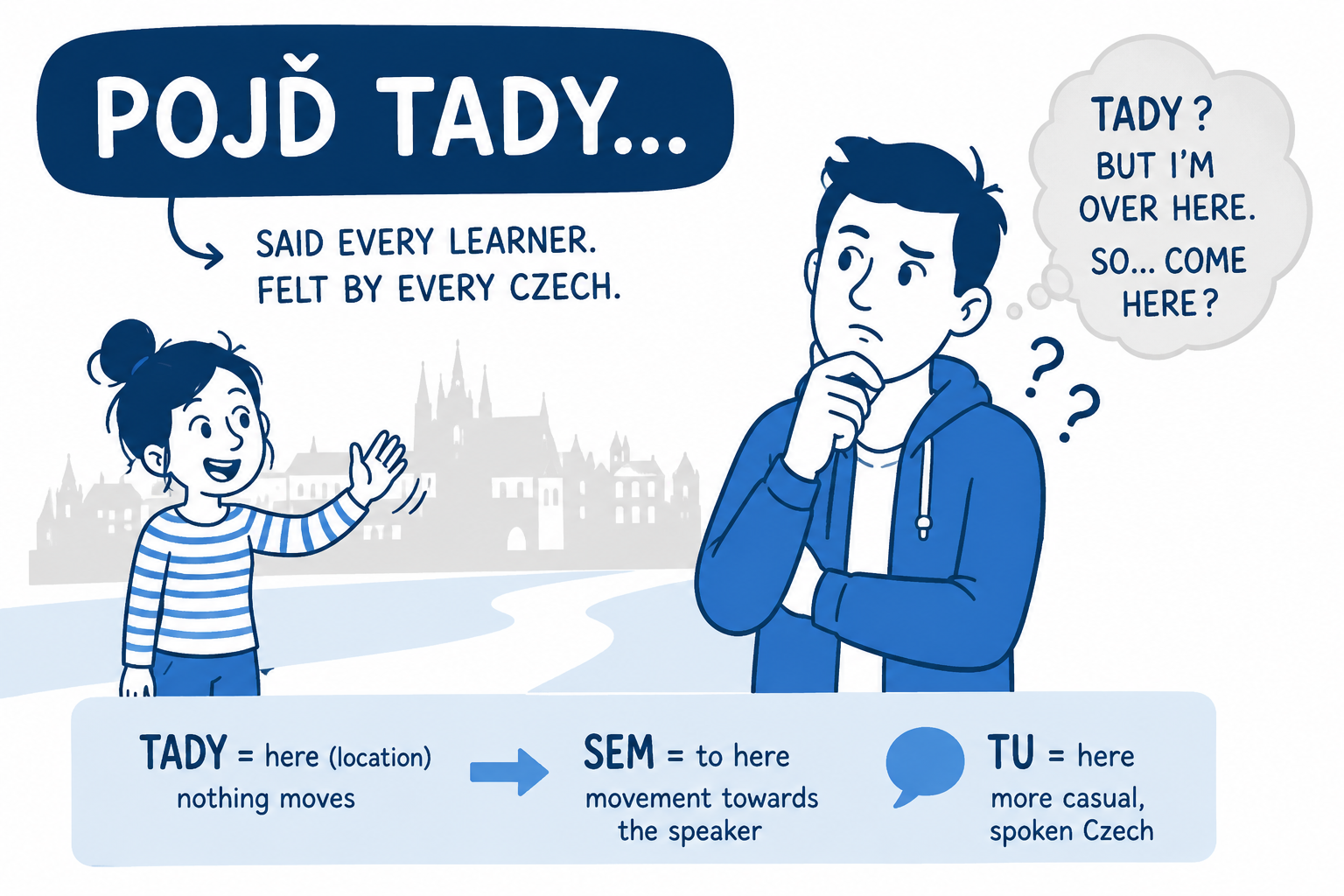
Pojď sem…is…much better.
This is not the kind of mistake that blocks communication. People will understand you every time. But it is exactly the kind of detail that makes your Czech sound either slightly off… or surprisingly natural. And once you notice it, you’ll start hearing it everywhere. Czech is not hard. It’s just very precise.
Speak Czech that sounds right. This cheat sheet shows you exactly how adverbs work, how to form them from adjectives, and how to compare them (fast → faster → fastest). You’ll also master place adverbs (sem/tady/odsud), weather phrases (Je krásně.), and natural double negation (Nikdo nic neví.). Packed with friendly explanations and bite-size examples you can copy into real life.
Perfect for:
Learners who want fast, practical progress
Anyone who confuses dobrý vs dobře (you won’t after this!)
Busy students who like clear rules + lots of examples
