How to Say Dates in Czech (Without Confusing Everyone Around You)
Have you ever tried to say your birthday in Czech… and suddenly realized you don’t know how? You know the numbers. You know the months. But when you try to say something simple like “I was born on May 5th,” everything falls apart.
Instead of a smooth sentence, you end up with something like:
pět květen…? — “five May…?”
Close. But very wrong.
The truth is: saying dates in Czech isn’t just about vocabulary. You need to know how to change the words and how to put them in the right order.
The good news? Once you understand the system, you’ll be able to confidently say things like: Narodil jsem se pátého května. — “I was born on May 5th.”
And that’s exactly what we’re going to learn in this article.
Why Czech Dates Feel So Different
In English, dates are easy:
“May 5th”
In Czech, the logic flips completely:
day + month (both change form)
So instead of “May 5th,” you say:
pátého května — “the fifth of May”
Yes — both words change. Czech is not here to make your life easier.
Step 1: Months (You Thought You Knew Them…)
First, the basic forms:
leden — “January”
únor — “February”
březen — “March”
duben — “April”
květen — “May”
červen — “June”
červenec — “July”
srpen — “August”
září — “September”
říjen — “October”
listopad — “November”
prosinec — “December”
Now the problem: in dates, you don’t use these forms.
You need the genitive case:
leden → ledna
únor → února
březen → března
duben → dubna
květen → května
červen → června
červenec → července
srpen → srpna
září → září (this one doesn’t change — small win)
říjen → října
listopad → listopadu
prosinec → prosince
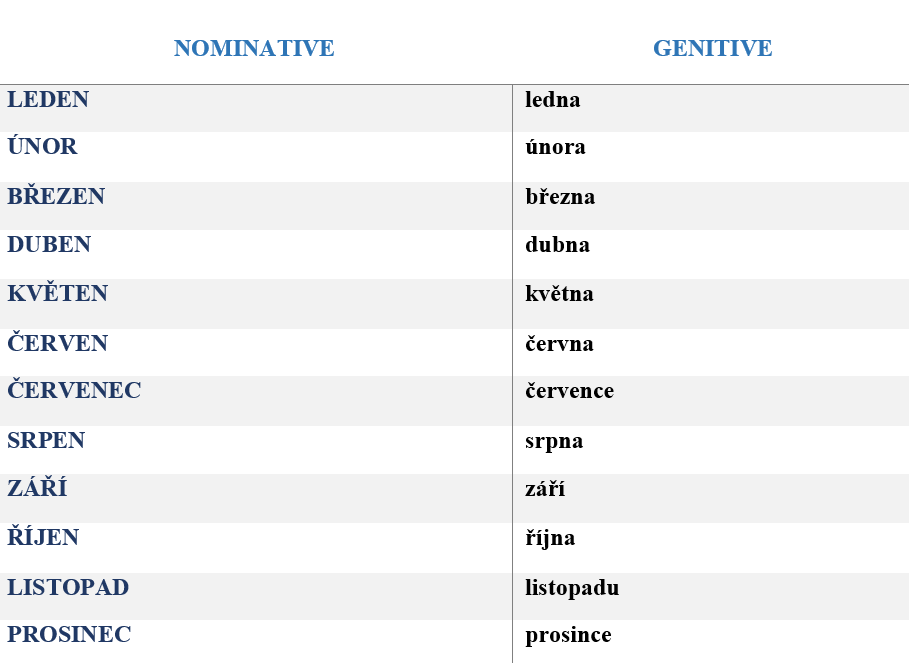
Cheat table for your fridge…
Step 2: Ordinal Numbers (This Is Where Students Suffer)
Dates don’t use one, two, three…
They use:
first, second, third…
In Czech:
prvního — “first”
druhého — “second”
třetího — “third”
čtvrtého — “fourth”
pátého — “fifth”
desátého — “tenth”
dvacátého — “twentieth”
třicátého prvního — “thirty-first”
You’ll notice the pattern: Most of them end in -ého.
That’s not decoration. That’s grammar.
Step 3: The Formula You Actually Need
Here it is: ordinal number (genitive) + month (genitive)
Examples:
pátého května — “May 5th”
dvanáctého června — “June 12th”
dvacátého prvního srpna — “August 21st”
třicátého září — “September 30th”
Step 4: How to Say Your Birthday
Now the sentence you actually care about:
Narodil jsem se pátého května. — “I was born on May 5th.” (male)
Narodila jsem se pátého května. — “I was born on May 5th.” (female)
Try plugging in your own date. This is the real goal.
Step 5: How to Write Dates (Don’t Mess This Up)
Czech written format:
25. 6. 2026 OR 26. června 2026
Rules:
Always use a dot after the number
Always use a space after the dot
Never write the name of the month with capitals
Real-Life Examples
Talking about plans:
Schůzka je pátého května.
“The meeting is on May 5th.”
Formal style:
Dne 12. června 2024…
“On June 12th, 2024…”
Asking someone:
Kdy máš narozeniny?
“When is your birthday?”
Answer:
Dvacátého třetího října.
“October 23rd.”
The Most Common Mistake
Let’s address it directly.
Students often say:
❌ “pátý květen”
❌ “pět květen”
This sounds unnatural or just wrong.
Correct:
✔ pátého května
Remember: both words must change — not just one.
If you can say your birthday correctly in Czech, you’ve just mastered:
numbers
That’s not a small thing. That’s real progress.
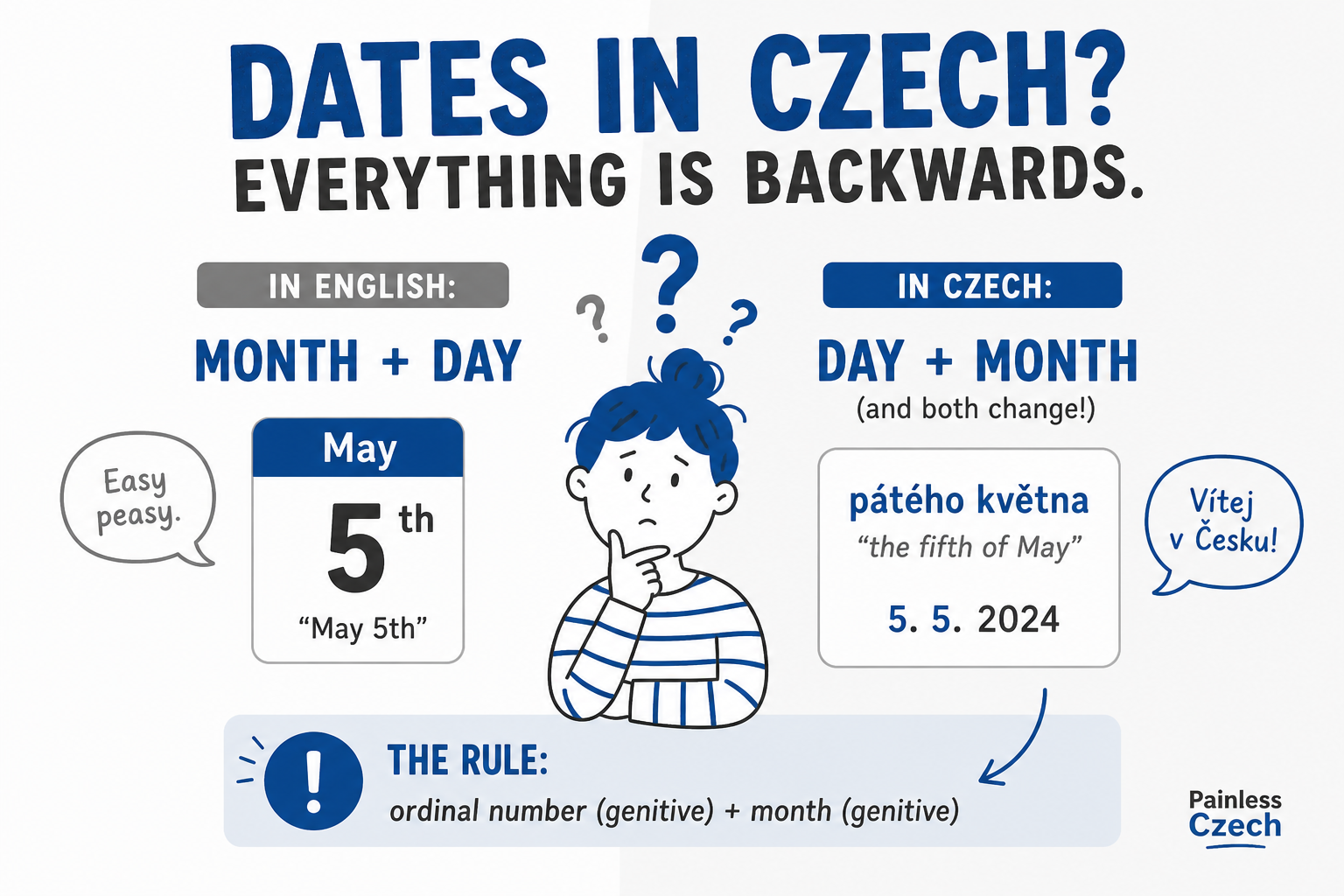
In Czech the day ALWAYS comes first: 5. května 2024!
Stop guessing numbers in Czech and start using them naturally.
This clear, practical and beautifully structured cheat sheet helps you finally master Czech numbers the way they are actually used in real life in speaking, listening, and everyday conversations.
No boring theory. Just usable patterns, real examples, and the logic behind how Czech speakers really think about numbers.
Inside you'll learn:
all essential Czech numbers from 0–1,000,000+ (clean, practical overview)
how gender changes ONLY what really matters (1 and 2 — explained simply)
the 2–4 vs 5+ rule that controls Czech grammar after numbers
how to combine numbers naturally (dvacet jedna vs jednaadvacet)
spoken Czech reality (sedm → “sedum”, osm → “osum”)
how to use numbers with nouns without making mistakes
ordinals made easy (první, druhý, třetí…)
how to say “how many”, “which one”, and “how many times” like a native
real-life examples for travel, study, time, money, and daily conversation
If Czech numbers ever felt messy, inconsistent, or overwhelming — this sheet turns them into something logical, predictable, and actually usable.
Start thinking in Czech numbers, not translating them.
