How to say your age in Czech (without sounding like a confused tourist)
Let’s start with a completely normal situation. Someone asks you: Kolik ti je let?
You proudly say:
Jsem 25 let. OR even Mám 25 let.
There are two sentences every Czech learner says at some point. And both of them are wrong. Not “a bit off”. Not “cute foreigner mistake”. Just… completely wrong. And every Czech within a 10-meter radius feels a small grammatical disturbance in the universe.
And the worst part? They make perfect sense in English. Which is exactly why your brain insists on using them. Unfortunately, Czech does not care about your logic…
The core problem: Czech doesn’t “be” your age
In English, you are your age: I am 25.
In Czech? You don’t be your age. You have age happening to you. Yes. Really.
The correct structure
Je mi 25 let.
Literally: “It is 25 years to me.”
Welcome to Czech logic.
What is actually happening in this sentence?
Let’s break it down:
je → “it is”
mi → “to me”
25 let → “25 years”
So the structure is: “It is X years to me”
Which is why Jsem 25 let sounds wrong. You’re using the wrong verb and ignoring the structure.
The mysterious mi (this is where things get interesting)
That little word miis doing a lot of work. It is the dative case (3rd case) of já (I). Dative = “to/for someone”
So:
mi = to me
ti = to you (informal)
mu = to him
jí = to her
nám = to us
vám = to you (formal/plural)
jim = to them
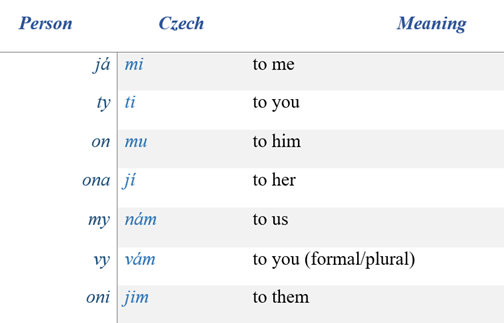
Dative pronouns (your survival table)
So how do you actually say your age?
Easy:
Je mi 30 let.
“It is 30 years to me.”
Je mi 18 let.
“It is 18 years to me.”
Asking someone’s age (be careful…)
Informal:
Kolik ti je let?
“How many years is it to you?”
Formal:
Kolik vám je let?
“How old are you?” (polite)
Answering like a normal human
Je mi 25 let.
“I am 25.”Je mu 40 let.
“He is 40.”Je jí 32 let.
“She is 32.”Je nám 20 let.
“We are 20.”
Real-life situations (where things go wrong)
At a party:
Kolik ti je let?
Jsem 27 let. ❌
awkward silence
someone changes the topic to beer
At the doctor:
Kolik vám je let?
Je mi 45 let. ✔️
respect restored
Cultural reality (read this before asking anyone)
In Czech culture, asking about age is… situational.
With friends → totally fine
With strangers → a bit weird
With women 30+ → proceed with caution and good life insurance
What if you DON’T want to say your age?
No problem. Czech has solutions.
To je tajné.
“That’s a secret.”
Na to jsem moc mladý / mladá.
“I’m too young for that question.”
Radši neřeknu.
“I’d rather not say.”
Tipni si.
“Guess.”
(High-risk move. Use carefully.)
The one thing to remember
Stop translating from English.
Not: Jsem 25 let
But: Je mi 25 let
Think: “It is X years to me”
Once this clicks, you’ll never say it wrong again.
Want this to feel automatic?
If you’re tired of second-guessing basic things like age, numbers, and everyday expressions, you need to see how Czech actually works not how English thinks it works. That’s exactly why I created the Czech Numerals Cheat Sheet.
It helps you:
understand number structures instantly
use them correctly in real situations
stop translating in your head
So next time someone asks:
Kolik ti je let?
you won’t panic… you won’t freeze… you’ll just say: Je mi 25 let. like a fully functioning Czech speaker. (Well, if you are not 25, then perhaps learn how to say the correct number…)
Stop guessing numbers in Czech and start using them naturally.
This clear, practical and beautifully structured cheat sheet helps you finally master Czech numbers the way they are actually used in real life in speaking, listening, and everyday conversations.
No boring theory. Just usable patterns, real examples, and the logic behind how Czech speakers really think about numbers.
Inside you'll learn:
all essential Czech numbers from 0–1,000,000+ (clean, practical overview)
how gender changes ONLY what really matters (1 and 2 — explained simply)
the 2–4 vs 5+ rule that controls Czech grammar after numbers
how to combine numbers naturally (dvacet jedna vs jednaadvacet)
spoken Czech reality (sedm → “sedum”, osm → “osum”)
how to use numbers with nouns without making mistakes
ordinals made easy (první, druhý, třetí…)
how to say “how many”, “which one”, and “how many times” like a native
real-life examples for travel, study, time, money, and daily conversation
If Czech numbers ever felt messy, inconsistent, or overwhelming — this sheet turns them into something logical, predictable, and actually usable.
Start thinking in Czech numbers, not translating them.
