KÁMO: The Czech Word That Took Over the Streets (and the Internet)
If you learn only one informal Czech word this year, make it kámo.
It’s everywhere. In trams. In schools. In YouTube videos. In serious podcasts. Possibly even in places where it absolutely does not belong.
So what does kámo actually mean? Is it friendly? Rude? Gendered? Is it the new ty vole? And most importantly — can you use it without embarrassing yourself?
Let’s dive in.
What Does Kámo Mean?
Kámo is a colloquial shortening of:
kámoš
kamarád (friend)
It basically means:
friend
buddy
dude
bro
mate
But here’s the twist: It is not just a noun. It is mostly used as a form of address.
Core meanings
Friend / close person
Casual way to address someone
Friendly way to talk even to strangers
Emotional filler word (like “dude”)
How It’s Used in Real Czech Life
Talking to a real friend
Kámo, dneska jdeme na pivo.
"Bro, we're going for a beer today."
Ty jsi fakt dobrej, kámo.
"You’re really good, man."
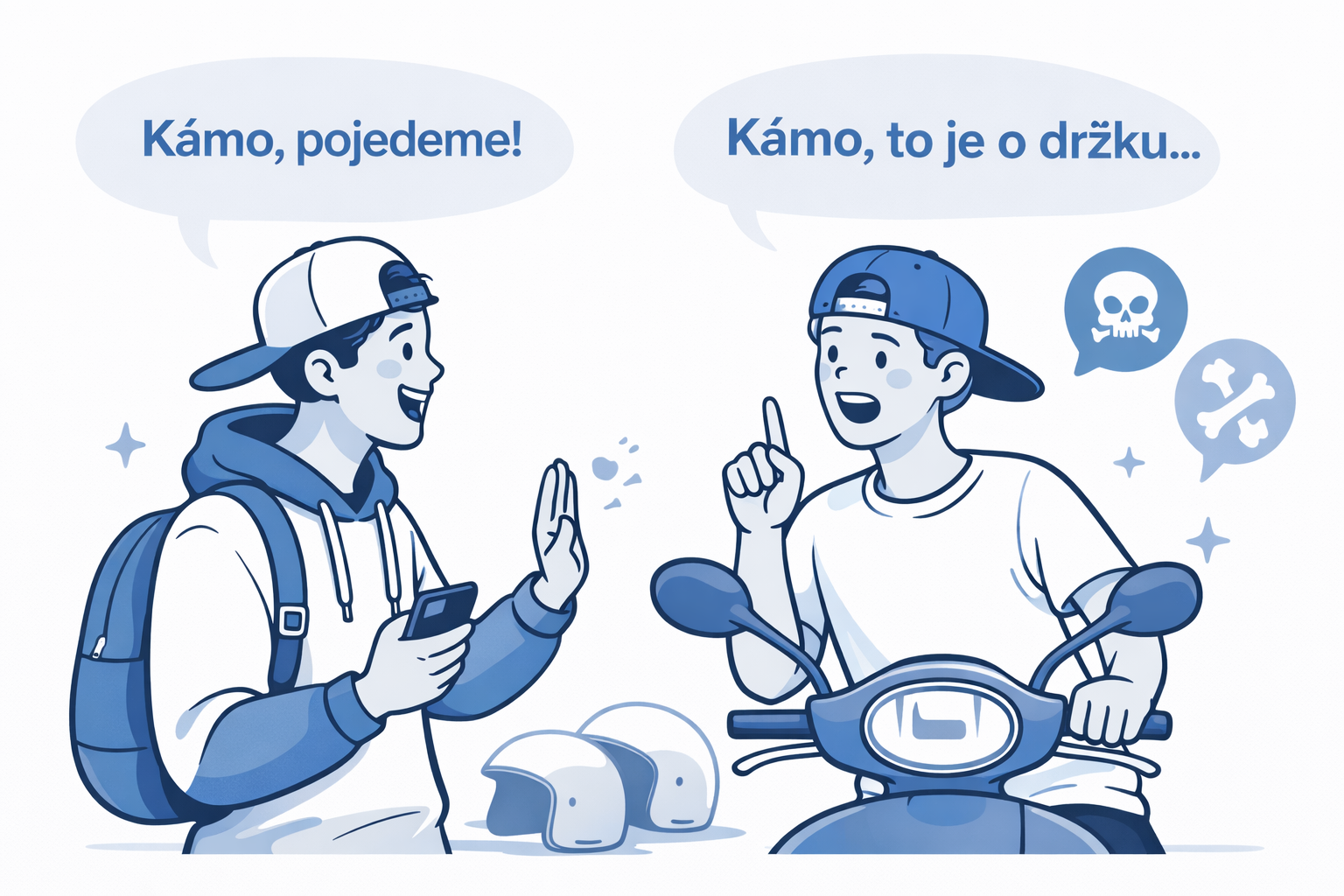
Kámo level: You say it 27 times a minute… and still think you sound completely normal.
As emotional punctuation
Like English “dude” it expresses surprise, stress, admiration, disbelief.
Kámo, to byl úplnej chaos.
"Dude, that was complete chaos."
Kámo, tys to dal?!
"Dude, you actually did it?!"
Sometimes it appears five times in one sentence:
Kámo, já ti říkám, kámo, to bylo fakt šílený, kámo.
"Dude, I’m telling you, dude, it was seriously crazy, dude."
Yes. This happens. Frequently.
To a stranger (modern Czech boldness)
Kámo, stojíš mi na batohu.
"Hey man, you’re standing on my backpack."
Kámo, tohle ti spadlo.
"Hey, you dropped this."
This is interesting. Czech used to prefer more… agricultural address forms (we’ll get there). Now kámo sounds softer, more urban, less aggressive.
The Great Shift: From “Ty Vole” to “Kámo”
For decades, one word dominated Czech casual speech: ty vole
Literally? “You ox.”
Emotionally? Everything.
Surprise, anger, joy, stress, existential crisis — ty vole handled it all.
But something changed.
Where ty vole feels raw, pub-like, slightly chaotic…
kámo feels smoother. More neutral. Almost cosmopolitan.
Compare:
Ty vole, to je průšvih.
"Man, this is a disaster." (rougher tone)
Kámo, to je průšvih.
"Dude, this is a disaster." (softer, more friendly)
Younger speakers increasingly prefer kámo. It sounds less vulgar, less confrontational. Even linguists have noticed this generational shift.
Is It Gendered?
Interestingly:
Boys say it.
Girls say it.
Girls say it to girls.
Girls say it to boys.
Sometimes even adults say it (carefully).
Kámo, já nemám data.
"Dude, I have no data."
It has become almost gender-neutral. Much like English “guys” or “dude.”
Tone Changes Everything
The meaning depends entirely on intonation.
Friendly
Kámo 🙂
"Buddy 🙂"
Shocked
KÁMO?!
"DUDE?!"
Disappointed
No kámo…
"Oh man…"
Threat level rising
Hele, kámo…
"Listen, man…"
Tone is everything. Written Czech often adds extra letters for drama:
Kááámo!
"Duuude!"
When NOT to Use It
Let’s be clear.
Do NOT say:
Kámo, pane soudce…
"Dude, Your Honor…"Kámo, paní učitelko…
"Dude, teacher…"Dobrý den, kámo.
"Good day, dude."
Unless your goal is social experimentation.
It is informal. Very informal.
Why Did It Become So Popular?
Several reasons:
Influence of English “dude” / “bro”
Youth identity building
Softer alternative to vulgar expressions
Social media & video culture
Urban slang spreading nationwide
Linguists point out that young people constantly create identity through language. What shocks one generation becomes normal for the next.
Every generation thinks the previous slang was “better.”
And then suddenly you’re 50, standing at a tram stop in 2050, hearing teenagers say something new like:
Zorbo, to byl glitch století.
"Zorbo, that was the glitch of the century."
And you whisper:
Jo, kámo… to byly časy.
"Yeah, dude… those were the days."
Synonyms of “Kámo”
Depending on region and style:
kámoš – buddy
kamarád – friend
brácha – bro
borec – dude / cool guy
týpek – guy
maník – dude
Each has slightly different vibes. But kámo is currently the king.
Final Survival Advice
If you are a Czech learner:
✔ Use it with friends.
✔ Use it in relaxed environments.
✔ Use it when joking.
❌ Do not use it in official situations.
❌ Do not overuse it unless you want to sound like a 15-year-old TikToker.
One well-placed kámo is cool.
Five per sentence? Risky.
Czech evolves. Words come and go.
But right now?
Kámo is driving the bus.
And whether you like it or not…
Kámo, tak to prostě je.
"Dude, that’s just how it is."
Tip: Listen to this song while reading about kámo vibes. Rybičky 48: Kámo. Find the lyrics here.

Unlock the “friend” version of Czech. This friendly, funny mini-guide shows you how Czechs actually talk with their buddies — from tykání vs. vykání (and when to switch) to real pub phrases, the truth about vole, and the Swiss-army verb dát si.
Packed with natural examples, mini-dialogues (with translations), and culture notes so you sound like a kámoš, not a textbook.
You’ll learn:
How and when to move from vy → ty (with the key phrase Můžeme si tykat?).
The difference between kamarád/kamarádka vs. přítel/přítelkyně (and how to avoid accidental boyfriend/girlfriend intros).
Everyday friend phrases you’ll actually use (from Čau! to V pohodě and Jasně).
What vole really means, when it’s okay, and when it’s… really not.
The power of dát / dát si in real life (Co si dáš?, Dej si pozor, Dej mi vědět).
Perfect for: A1–B2 learners who want real-world Czech for friends, pubs, and everyday chats.
