Reflexive Verbs in Czech: The Selfie Words You Can’t Avoid
If you’ve ever tried speaking Czech and felt like every second word ends with -se or -si, you’re not wrong. Czech is packed with reflexive verbs. They’re short, sneaky, and absolutely everywhere.
Think of reflexive verbs as the language’s built-in selfie feature. Instead of looking outward, they often flip the action back to the speaker: vidím se, myji se, odpočinu si (I see myself, I’m washing myself, I’m giving myself a break). But in Czech, reflexives go way beyond that. Sometimes se and si change the meaning completely and if you use the wrong one, you might end up saying something hilariously awkward…
What Are Reflexive Verbs in Czech?
Reflexive verbs are those little creatures in Czech that come with an extra word: se or si. You’ll see them all the time. So often that beginners sometimes think se/si is just random decoration. But no: it’s doing important grammatical work.
Think of reflexive verbs as verbs with a built-in twist. The action either:
Loops back to the subject (I wash myself, he introduces himself), or
Happens for the subject’s own benefit (I buy myself coffee, she gives herself a break).
That’s why many Czech verbs appear in pairs: učit (to teach) vs. učit se (to learn), dát (to give) vs. dát si (to have, for oneself).
Some verbs simply don’t exist without se/si, these are called reflexiva tantum. For example:
smát se – to laugh
jmenovat se – to be called, to be named
vrátit se – to return
Drop the reflexive, and the sentence either changes its meaning completely or stops making sense altogether. So if you want to sound natural in Czech, you can’t avoid reflexives. But don’t worry, once you understand the simple logic behind se and si, everything falls into place.
SE = Action Directly Back to the Subject
Use SE when the subject is doing something to themselves. It’s like a mirror: the action bounces right back.
Examples:
Já se vidím. – I see myself.
On se učí česky. – He is learning Czech.
Díváme se na televizi. – We’re watching TV.
Notice that here, se doesn’t mean “each other” or “for oneself.” It just says: “Hey, the subject and the object are the same person.”
Funny mix-up:
If you forget se in učit se, you’ll say:
Učím česky. → I teach Czech.
instead ofUčím se česky. → I’m learning Czech.
That’s a big difference, unless you really are a Czech teacher!
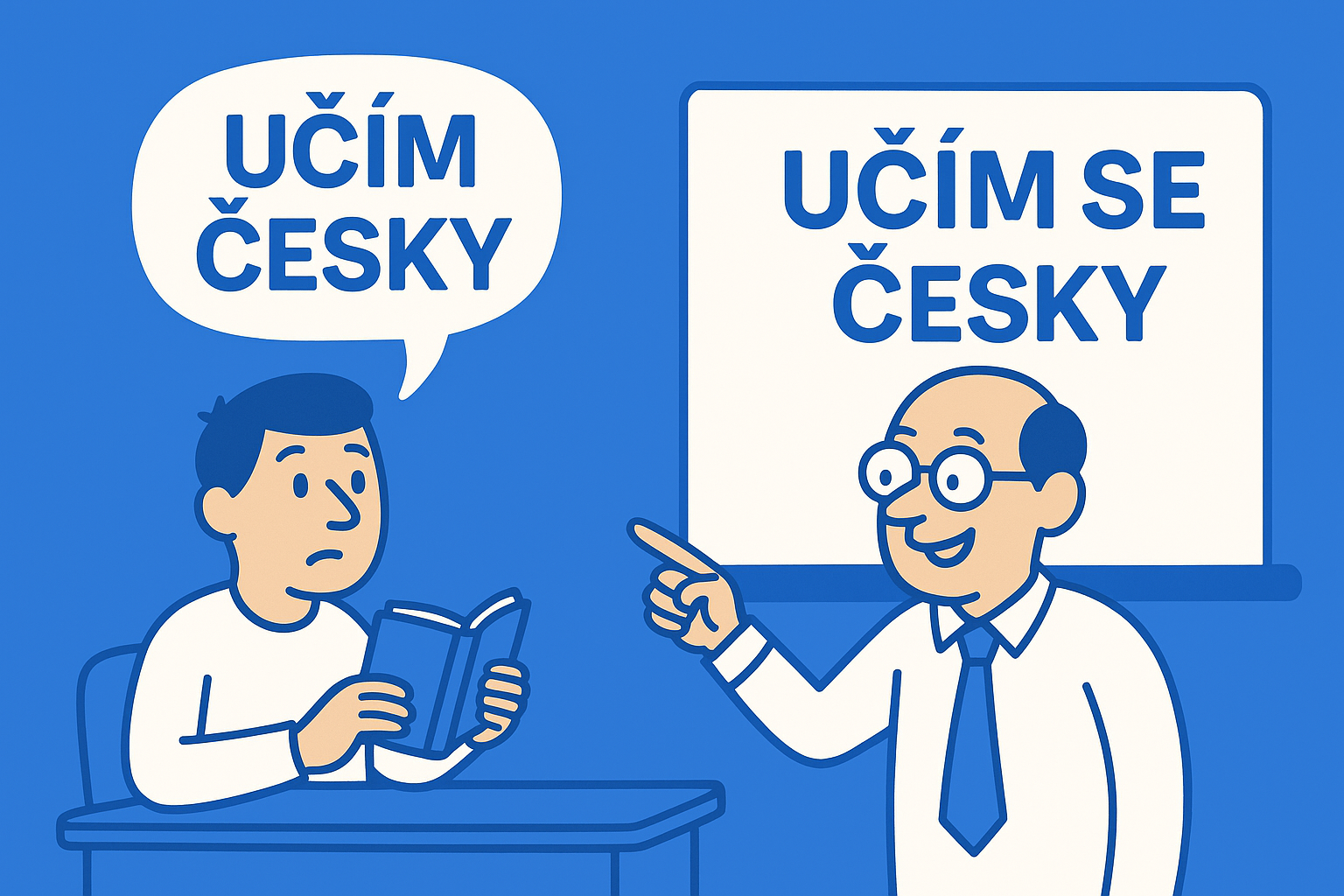
Would you like to take the place of your Czech teacher?
SI = Doing Something for Your Own Benefit
Now enter SI. This one is trickier. Use it when you’re not the direct object, but you’re doing something for yourself.
Examples:
Koupím si knihu. – I’ll buy myself a book.
On si dává kávu. – He’s having (for himself) a coffee.
Přeju si dovolenou. – I wish for a holiday.
So si doesn’t mean you’re the target of the action. It means you’re the one who benefits.
Real-Life Examples You’ll Actually Use
Jak se máš? – How are you? (literally: how do you yourself have?)
Jmenuju se Tom. – My name is Tom.
Musíme se rozhodnout. – We need to decide.
Kup si něco dobrého. – Buy yourself something nice.
Neuč se tolik, dej si pauzu! – Don’t study so much, give yourself a break!
Word Order Trick
The reflexive pronouns se/si are clitics, which is a fancy way of saying: they hate standing at the beginning of a sentence. They always want the second spot.
Dnes se učím česky. – Today I’m learning Czech.
Já se učím česky. – (Same meaning, but with emphasis on “I.”)
Učím se česky. – I’m learning Czech.
The position of se/si is so stable that native speakers don’t even think about it. But once you notice it, you’ll hear it everywhere.
Quick SE vs. SI Recap
SE = direct mirror (I wash myself, I teach myself, I see myself).
SI = for my own benefit (I buy myself, I give myself, I wish for myself).
Mix them up, and you might say:
Dám se kávu. → Sounds like “I will give myself (as) coffee.”
Instead of:Dám si kávu. → I’ll have a coffee (for myself).
Big difference and one worth remembering next time you order in a Czech café!
Czech verbs are messy, but they don’t have to be. That’s why I created the Czech Verbs Cheat Sheet, your all-in-one survival kit for Czech verbs. Grab it to finally make sense of conjugation, negatives, past & future tenses, verbs of motion, reflexives, and more.
