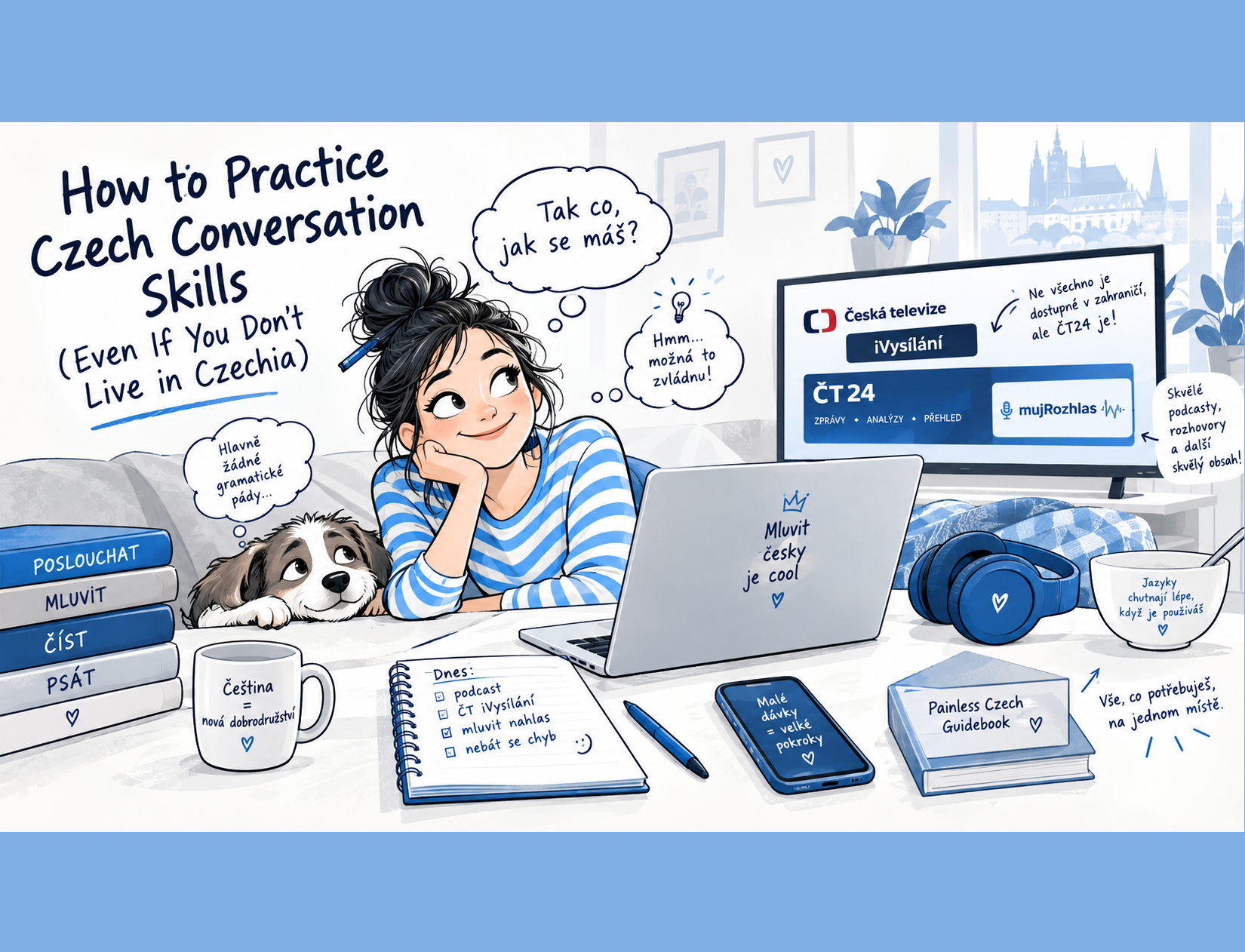
How to Practice Czech Conversation Skills (Even If You Don’t Live in Czechia)
You know Czech grammar. You know plenty of vocabulary. So why does your brain suddenly go blank when a Czech person asks, „Tak co, jak se máš?“ Learn practical, painless ways to turn the Czech you understand into Czech you can actually speak.

How to Survive a Czech Supermarket (Without Accidentally Buying Half the Store)
Shopping in a Czech supermarket can be surprisingly intimidating when you're learning the language. From finding the butter to ordering sliced ham at the deli counter and surviving the cashier's rapid-fire questions, this article teaches you the Czech you'll actually use while grocery shopping.

Czech Connectors That Will Make You Sound Instantly Local
Tired of sounding like you’re sending Czech by Morse code? Learn the 5 connectors Czechs can’t live without and watch your Czech transform from robotic to effortlessly local.

Czech Past Tense Secrets: Why We Write -l, -la, -li, -ly (and What It Tells You About Who Did It)
Why do Czechs write pracovali, pracovaly, or even pracovala? Welcome to the wonderful chaos of Czech past participles where endings reveal who did what, and even how many puppies were involved. Learn how -l, -la, -lo, -li, -ly, -la endings secretly tell a whole story and how to finally master them (without crying over grammar tables).

How to Survive (and Actually Pronounce) the Czech Ř
Think Ř is impossible? Even Czech kids need years of speech therapy to get it right including me! In this fun, honest guide, learn how to finally pronounce the Czech Ř without losing your mind (or your tongue).

“Ty vole!” — The Czech Phrase That’ll Make You Sound Instantly Local
Think Czech is all about grammar and cases? Think again, vole! This word is the ultimate Czech friendship tool: part insult, part affection, part verbal glue. Learn how to use it like a local (and when not to shout it at your boss).

Every Preposition Owns a Case (Because Czech Prepositions Are Tiny Dictators with Serious Control Issues)
Czech prepositions may look small, but they rule the grammar kingdom with an iron fist. Learn why every preposition “owns” a case, how to finally understand their logic, and when to use do, na, v, za, and friends all with humor, new examples, and Czech reality checks.

What You Can (and Absolutely Shouldn’t) Talk About at a Czech Family Dinner
You’ve survived the řízek and the koláč but now comes the real challenge: Czech small talk. Learn which dinner topics are safe, which ones to avoid, and how to win your Czech family’s heart with humor (and good manners).

“This Is My …“ — How to Talk About Your Partner in Czech (Without Accidentally Adopting a Child)
How do you say “boyfriend” or “girlfriend” in Czech without confusing everyone? Learn the real meanings behind přítel, kluk, partner, and muž or přítelkyně, holka, partnerka and žena to avoid an accidental friendzone in translation.

Which Czech Exam Should You Take? CCE–A2 vs. CCE–B1 Explained
Confused about which Czech exam you need? This article breaks down the difference between CCE–A2 (for permanent residence) and CCE–B1 (for citizenship). Learn what each exam looks like, where to take it, and how to prepare with step-by-step study plans.