Ti or Tobě? The Czech Pronoun Drama You Didn’t Know You Signed Up For
If you’ve ever said:
Dám to tobě.
"I’ll give it to you."
and wondered whether you could say Dám ti to, congratulations. You’ve entered the world of clitic pronouns…those tiny, sneaky little words that refuse to stand at the beginning of a sentence and insist on being in second position like divas with placement requirements.
Let’s break this down in a way that actually makes sense.
The Core Rule: Short vs. Long Forms
In Czech dative (and accusative), personal pronouns often have:
a short (clitic) form → mi, ti
a long (stressed) form → mně, tobě
Short Forms (mi, ti)
Used when:
There is no preposition
The pronoun is unstressed
It sits in the famous second position
Examples:
Dám ti knihu.
"I’ll give you a book."
Pošlu ti e-mail.
"I’ll send you an email."
Řeknu ti pravdu.
"I’ll tell you the truth."
Ukázal mi fotku.
"He showed me a photo."
Notice something? The pronoun sneaks into second position like it owns the place.
Long Forms (mně, tobě)
Used when:
The pronoun comes after a preposition
You want to emphasize
It stands alone or carries stress
After Prepositions (Non-Negotiable Rule)
If there is a preposition, short forms are illegal.
Bez tebe to nejde.
"It doesn’t work without you."
K tobě nepřijdu.
"I won’t come to you."
O mně se nemluvilo.
"They weren’t talking about me."
Never:
❌ Bez ti
❌ K ti
Czech would simply faint.
Emphasis Changes Everything
Even without a preposition, you can choose the long form for emphasis.
Compare:
Dám ti dárek.
"I’ll give you a present." (neutral)
Dám dárek tobě.
"I’ll give the present to YOU." (not someone else)
Another example:
Řekl mi to.
"He told me."
Řekl to mně, ne tobě.
"He told ME, not you."
See the difference? Long form = spotlight moment.
The Other Big Confusion: mi vs. mě vs. mně
Welcome to the Czech nightmare trio.
Quick Map
mi → dative short form (to me)
mně → dative long form (to me, stressed), also locative
mě → accusative (me), also genitive
Let’s untangle it.
Dative: “to me”
Short (unstressed):
Dej mi čas.
"Give me time."
Napiš mi zítra.
"Write to me tomorrow."
Long (after preposition or emphasis):
Ke mně nepřijde.
"He won’t come to me."
To mně se to nelíbí.
"I don’t like it." (emphasizing ME)
Accusative: “me”
This is mě.
Vidíš mě?
"Do you see me?"
Znáš mě dobře.
"You know me well."
Prosím tě, poslouchej mě.
"Please, listen to me."
Never say:
❌ Vidíš mi?
That would mean something like “Do you see to me?” which is… not a thing.
Genitive: also mě
Yes, surprise. Used mostly after negation or certain prepositions.
Beze mě to nejde.
"It doesn’t work without me."
Nemáš mě rád.
"You don’t like me."
Bojí se mě.
"He’s afraid of me."
Locative: mně (6th case)
Used after specific prepositions like o.
O mně se bavili.
"They were talking about me."
Po mně to chceš?
"You want that from me?"
Notice something?
If there is a preposition and it's not accusative/genitive context, you’ll often see mně.
The Survival Trick
If there’s:
no preposition → probably mi (dative short)
preposition + “about” type meaning → mně
direct object → mě
negation or “without” → often mě
emphasis → long form (mně)
Czech pronouns aren’t random. They follow stress and case logic. But yes, they do enjoy psychological warfare.
The Magic Trick: Second Position Rule
Short forms (mi, ti, mu) cannot:
Start a sentence
Be stressed
Stand alone
You cannot say:
❌ Ti dám knihu.
Instead:
Já ti dám knihu.
"I’ll give you a book."
or simply:
Dám ti knihu.
They must sit comfortably in second position — not first, not wandering freely.
Plural Bonus: nám and vám
Good news: plural forms are less dramatic.
There’s no short vs. long difference.
Dám vám vědět.
"I’ll let you know."
Řekli nám pravdu.
"They told us the truth."
K nám nepřijdou.
"They won’t come to us."
Easy. Beautiful. Cooperative.
Real-Life Situations (So You Don’t Sound Weird)
At work:
Můžu ti pomoct?
"Can I help you?"
Better than:
Můžu pomoct tobě?
(Unless you’re emphasizing YOU specifically.)
In an argument:
To jsi mi nemusel říkat.
"You didn’t have to tell me that."
But if dramatic:
To jsi nemusel říkat mně!
"You didn’t have to tell ME!"
Romantic Czech:
Chybíš mi.
"I miss you."
Notice it’s dative. Literally: “You are missing to me.”
If you say:
❌ Chybíš mě.
That’s grammatical chaos.
Why Does Czech Even Do This?
Because Czech loves rhythm and stress patterns. Short forms are clitics — unstressed particles that lean on other words. Long forms carry stress and clarity.
Think of it like:
Short form = casual whisper
Long form = dramatic spotlight
Ultra Quick Cheat Sheet
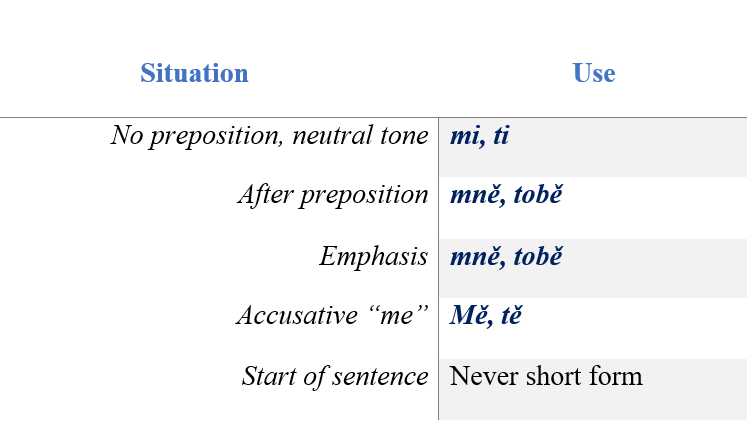
Try putting a short form at the beginning of a sentence? Linguistic scandal.
Final Test
Which one sounds right?
Dám ti to.
"I’ll give it to you." ✅
Dám to tobě.
"I’ll give it to YOU." ✅ (emphasis)
K ti přijdu. ❌
K tobě přijdu.
"I’ll come to you." ✅
Vidíš mi? ❌
Vidíš mě?
"Do you see me?" ✅
Want the Full Visual Breakdown?
If you want a clean, printable, zero-chaos overview of all Czech personal pronouns (short vs. long forms, cases, positions, prepositions, everything in one place), grab my Czech Pronouns Cheat Sheet.

Master Czech pronouns with this clear, student-friendly guide. The cheat sheet shows you how to use personal, possessive, demonstrative, interrogative, relative, indefinite, negative, and reflexive pronouns, all with simple explanations, declension tables, and real-life examples. It’s your survival kit for tricky Czech grammar, presented in a clean and easy layout.
