What Is a Czech Kobliha? The Sweet Difference Between Czech and American Donuts
Imagine you've just landed in Prague. You walk into a bakery, spot a beautiful round pastry dusted with powdered sugar and confidently think:
"Ah yes. A donut."
Congratulations. You've just committed your first cultural crime. Because while an American donut and a Czech kobliha may look like distant cousins in a family reunion photo, they grew up in very different households. One became an Instagram influencer. The other still spends Sundays at Grandma's house. Let's meet both of them. First of all...
What exactly is a kobliha?
A kobliha is a fluffy yeast dough pastry that's deep-fried until golden, then generously filled with jam, traditionally apricot, although plum, strawberry, raspberry, vanilla cream, chocolate, and even eggnog fillings have become common today. Finally, it's covered with powdered sugar.
Notice something missing?
The hole.
Americans see a hole. Czechs see an opportunity for more jam. Honestly, who's right here?
The American donut
The American donut is often defined by its hole. It comes with colorful icing. Sprinkles. Bacon. Breakfast cereal. Cookie crumbs. Another smaller donut on top of it. Sometimes enough sugar to temporarily unlock a fifth dimension. It's wonderful. It's the Las Vegas of pastries.
The Czech kobliha
The Czech kobliha is much more reserved. She doesn't need pink frosting. She doesn't need rainbow sprinkles. She simply arrives, quietly covered in powdered sugar, filled with homemade jam, and somehow everyone immediately respects her. She's basically the grandmother who never raises her voice but somehow controls the entire family.
The biggest difference isn't the recipe. It's the philosophy.
American donut: "Look at me!"
Czech kobliha: "I don't need attention. I know I'm delicious."
Vocabulary you absolutely need
Let's imagine you've entered a Czech bakery.
You'll probably hear words like these:
Jednu koblihu, prosím.
"One doughnut, please."
Máte koblihy s meruňkovou marmeládou?
"Do you have doughnuts with apricot jam?"
Jakou máte náplň?
"What fillings do you have?"
S malinovou.
"With raspberry."
Se švestkovými povidly.
"With plum butter."
S vanilkovým krémem.
"With vanilla cream."
Je čerstvá?
"Is it fresh?"
(Asking this at 7 a.m. is slightly offensive. Of course it's fresh.)
Wait... what is povidla?
This deserves its own section. Foreigners often translate povidla as jam. Close. But not quite. Povidla are thick plum preserves made without the huge amount of added sugar that regular jam usually contains. They're darker, richer and more intensely fruity. If jam is pop music... povidla are jazz.
Bakery survival: a real conversation
You walk into a Czech bakery. The salesperson smiles. Well, maybe...
You say:
Dobrý den.
"Good morning."
Prosím jednu koblihu s meruňkovou marmeládou.
"One doughnut with apricot jam, please."
The salesperson asks:
Ještě něco?
"Anything else?"
This question has trapped beginners for decades. Many panic. Some accidentally order five breads. Others simply freeze.
The correct responses are:
To je všechno, děkuji.
"That's all, thank you."
or
Ano, ještě jeden rohlík.
"Yes, one more bread roll."
(This is just for demonstration purposes. Nobody buys just “jeden rohlík”. Buy five and you’ll feel more Czech instantly!)
Congratulations. You've survived Czech bakery small talk.
Cultural insight: Why Czechs love koblihy
A kobliha isn't just a pastry. It's tradition.
Historically, koblihy were closely connected with Masopust, the Czech carnival season before Lent. During Tučný čtvrtek (Fat Thursday), people traditionally ate rich foods before the fasting period began. Koblihy became one of the iconic treats of the celebration and have remained a beloved part of Czech food culture ever since. Some historians trace Czech koblihy all the way back to the Middle Ages, when specialist bakers known as kobližníci were already making them.
Even today, bakeries sell thousands of them during carnival season. Because if you're about to give up sweets for forty days... you should obviously start by eating six. Science.
Every Czech child knows...
O Koblížkovi
If you grew up in the Czech Republic, you almost certainly know the fairy tale O Koblížkovi. Think of it as the Czech cousin of The Gingerbread Man. A freshly baked little doughnut rolls away from home, proudly escapes everyone who wants to eat him, sings his little song, becomes increasingly overconfident... and eventually meets someone much cleverer.
Spoiler alert: Arrogance is bad for your health. Especially if you're made of fried dough.
It's one of those stories every Czech child hears, which is why koblížek instantly feels nostalgic to many adults.

S koblížkem to nedopadne dobře…
Tip: Read the whole fairy tale on Pohádkozem website.
How to make authentic Czech koblihy
If you'd like to bring a little Czech bakery into your own kitchen, here's a classic version.
Ingredients
500 g plain flour
250 ml warm milk
30 g fresh yeast (or 7 g instant)
50 g sugar
50 g melted butter
4 egg yolks
1 tablespoon rum (yes, really—it helps reduce oil absorption)
pinch of salt
grated lemon zest
apricot jam (meruňková marmeláda)
oil for frying
powdered sugar
Method
Mix the yeast with a little warm milk and sugar and leave it to activate.
Combine all ingredients into a soft dough and knead until smooth.
Let it rise for about an hour.
Roll out the dough, cut circles, fill with jam (or fill after frying if you prefer), seal carefully, and let them rise again.
Fry until golden on both sides.
Dust generously with powdered sugar.
Eat one while it's still warm.
Immediately reach for a second one.
Pretend the first one never happened.
Traditional recipes almost always include apricot jam, egg-rich yeast dough, and a splash of rum, with the finished koblihy generously dusted with powdered sugar.
Tip: Watch the video recipe for homemade Czech donuts here.
Final Czech lesson
Here's something wonderfully Czech.
The singular is: kobliha
The plural is: koblihy
Not koblihas. Not koblihases. And definitely not koblihi. Czech grammar likes to keep you humble.
One last thing...
If you walk into a Czech bakery knowing how to ask for a kobliha, you're no longer just buying pastry. You're participating in a tiny piece of Czech culture. And trust me, it's much more satisfying than pointing at the display and hoping for the best.
Ready to survive your next Czech bakery?
If you'd like to order koblihy, coffee, pastries, sandwiches, and everything else with confidence, check out my Czech Coffee Shop Survival Vocabulary Sheets. They're packed with the real Czech you'll actually hear in bakeries and cafés, plus natural dialogues, pronunciation tips, and phrases locals use every day.
Because life's too short to accidentally leave a Czech bakery with three loaves of bread when all you wanted was one kobliha.
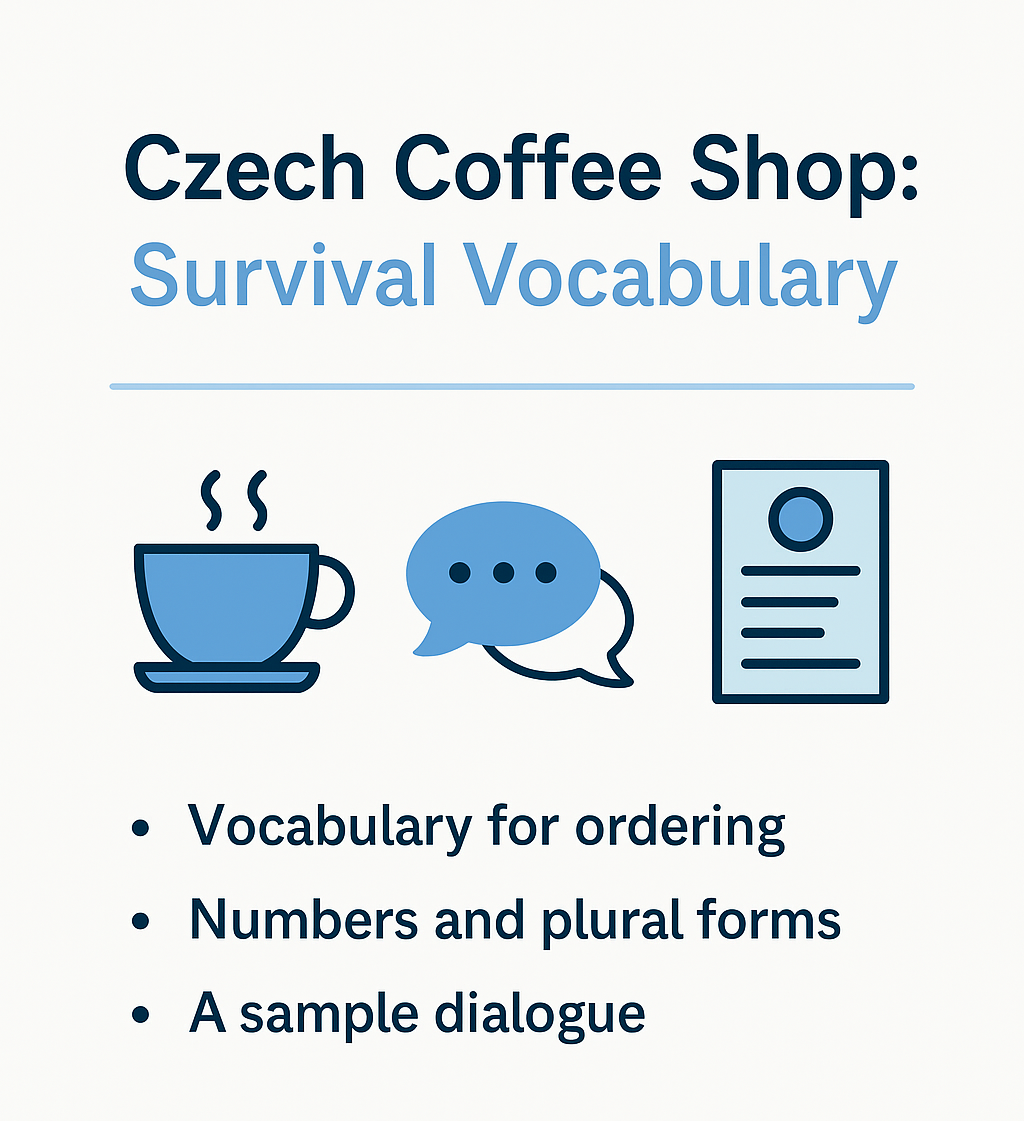
Master Czech in the café – one cappuccino at a time!
This practical sheet is your survival guide to the Czech coffee shop jungle. Inside, you’ll discover:
Essential café vocabulary – from espresso to oat milk, learn how to order like a local.
Ready-to-use phrases – no grammar headaches, just sentences you can say right away.
Numbers made simple – understand why it’s dvě kávy but pět káv, with easy examples.
Cultural insights – what Czechs mean by pražská kavárna or kavárenský povaleč.
A real café dialogue – practice a short conversation with a barista.
Bonus: sample menu – so you know exactly what you’re ordering.
Perfect for beginners, this sheet combines culture, grammar, and real-life language so you can sit down in any Prague café with confidence.
