How to Call People by Name in Czech: Mastering the Vocative of Czech Surnames
If you’ve ever proudly said pane Novák! instead of pane Nováku!, there’s a decent chance a Czech person silently judged you… or loudly corrected you. Welcome to the wild world of the vocative case, the form you use when directly addressing someone.
Good news: it’s not random chaos. Bad news: it’s not entirely predictable either. But don’t worry, we’ll make it painless (and maybe even fun).
Why the Vocative Exists (and Why Czechs Care)
Czech uses the vocative when speaking to someone, not about them.
Pane Nováku, pojďte sem. — “Mr. Novák, come here.”
NOT: Pan Novák (this sounds unfinished or foreign)
Using the wrong form can feel unnatural or overly stiff like calling your teacher “Hey, John Smith” instead of “Mr. Smith.”
The 10 Most Common Czech Surnames (and Their Vocative Forms)
Let’s start with real-life names you’ll actually hear:
The Main Patterns (a.k.a. How to Sound Like You Know What You're Doing)
Names ending in -ák → add -u
Novák → Nováku
Dvořák → Dvořáku
This is your safest bet. If in doubt and it ends in -ák, go with -u.
Names ending in -a → change to -o
Svoboda → Svobodo
Procházka → Procházko
Kučera → Kučero
Yes, even though these look “feminine,” many Czech male surnames end in -a. Czech does not care about your expectations.
Names ending in -ý → usually no change
Novotný → Novotný
Černý → Černý
Veselý → Veselý
Convenient? Yes. Suspiciously easy? Also yes.
Names ending in consonants → often add -e
Němec → Němče
Švec → Ševče
This group is trickier because consonant changes can happen:
-ec → -če (Němec → Němče)
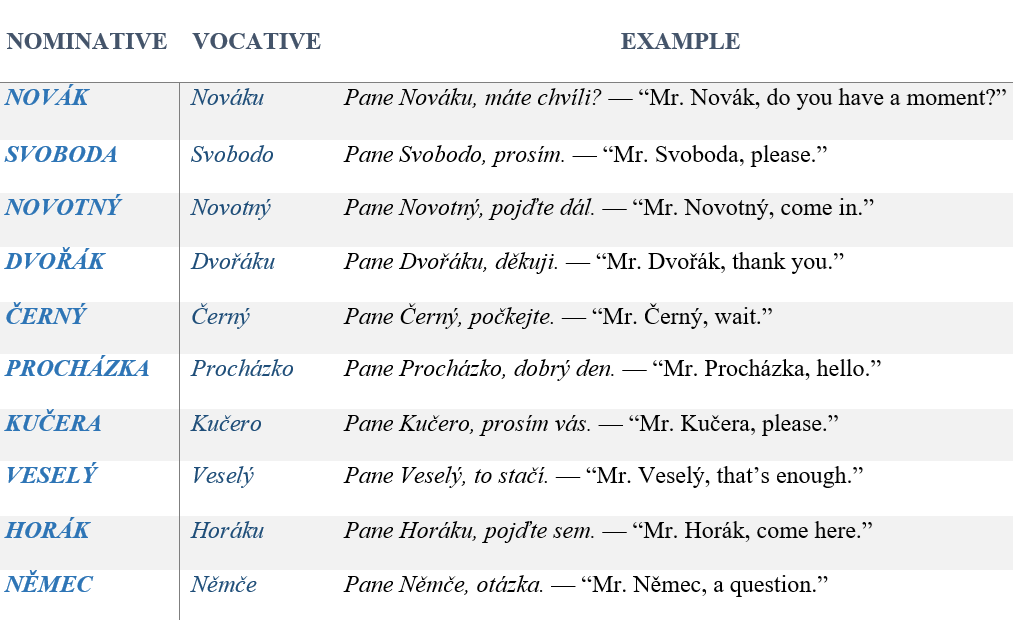
The 10 Most Common Czech Surnames
What About Women’s Surnames?
Traditionally, Czech female surnames are “přechýlené” (feminine forms):
Novák → Nováková
Svoboda → Svobodová
Vocative:
Nováková → Nováková (same form)
Svobodová → Svobodová
Example:
Paní Nováková, pojďte dál. — “Mrs. Nováková, come in.”
But here’s the twist:
These days, many women choose not to use the -ová ending, especially in international contexts.
So you might hear:
paní Novák instead of paní Nováková
And in that case:
Paní Novák, prosím. — “Mrs. Novák, please.”
This is becoming more common, but in traditional Czech grammar (and many formal situations), the -ová form is still expected.
Common Mistakes (Don’t Be That Person)
Saying Pane Novák instead of Pane Nováku
Avoiding vocative completely because “it’s scary”
Overcorrecting everything into -e endings like a maniac
If you forget the vocative, people will still understand you. But if you use it correctly, you instantly sound more natural and slightly more Czech than your current level should allow.
Want to Actually Master This?
If you’re serious about cases (including the vocative), grab my Czech Cases Cheat Sheet. It breaks everything down clearly with examples you’ll actually use. Because yes, Czech has 7 cases… and no, ignoring them is not a long-term strategy.

Mastering Czech cases doesn’t have to be overwhelming. This Czech Cases Cheat Sheet is your ultimate grammar sidekick — clear, simple, and practical.
Whether you’re a total beginner or brushing up after a break, this 6 page printable sheet breaks down all 7 Czech noun cases with:
Easy-to-understand explanations
Case-by-case usage with examples
Common verbs and prepositions
Questions for each case (in Czech + English)
A printable summary table for quick reference
Handy links to trusted grammar resources
Designed with visual learners and habit builders in mind, this sheet helps you learn Czech grammar the smart way – one small win at a time.
