Stop Saying “Já” All the Time: Why Czech Isn’t About You
There’s a moment every Czech learner goes through. A dangerous moment.
A moment when you realize you’ve been saying já in every single sentence… and suddenly everything you say sounds like a dramatic monologue from a very self-centered movie character. Let’s fix that.
The Core Problem: Too Many “I”s
Students often speak like this:
Já jdu do práce.
"I go to work."
Já mám hlad.
"I am hungry."
Já chci pivo.
"I want a beer."
Grammatically? Fine. Naturally? Not even close.
To a Czech ear, this sounds like: “I go to work. I am hungry. I want a beer. I, I, I, I…”
Congratulations. You are now the main character of everything.
The Czech Reality: The Verb Already Knows It’s You
In Czech, the subject (like já, ty, on) is usually unnecessary, because it’s already hidden inside the verb.
Look at this:
Jdu do práce.
"I go to work."
The -u ending already tells us: I go. No need to announce yourself again like a celebrity entering a room.
The Golden Rule
If it’s obvious who is doing the action → drop the pronoun.
That’s it. That’s the whole magic trick.
Let’s Compare (and Feel the Difference)
Normal Czech:
Jdu domů.
"I'm going home."
Overloaded Ego Version:
Já jdu domů.
"I am going home."
The second one isn’t wrong. It just sounds like you’re correcting someone: “No, I am going home (not him, not her, ME).”
Another Example:
Máme čas.
"We have time."
vs.
My máme čas.
"We have time."
The second one implies contrast: “WE have time (but maybe you don’t).”
When “Já” Actually Makes Sense
Now here’s the twist: já is not forbidden. It’s just… dramatic. You use it when you want to emphasize or contrast.
Contrast
Já jdu do práce, ale on spí.
"I go to work, but he sleeps."
You’re highlighting the difference.
Correction
Kdo to udělal?
"Who did it?"
Já.
"I did."
Now já is doing real work.
Emphasis (a bit of attitude included)
Já to dělat nebudu.
"I am NOT doing that."
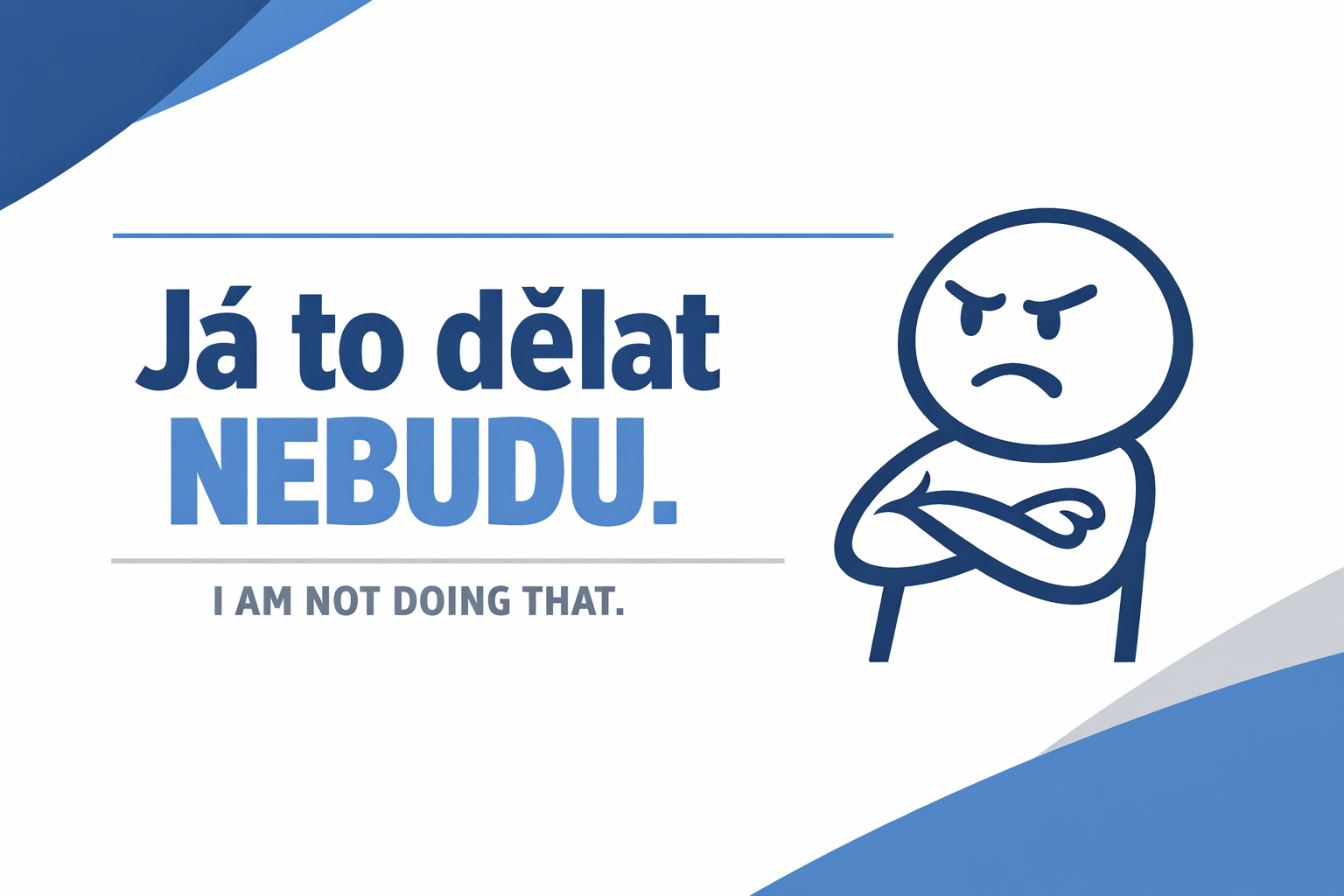
This has energy. Possibly conflict. Maybe even a small argument.
The Same Problem with Possessives
It’s not just já. Students also overuse possessive pronouns like můj, tvoje, jeho…
Let’s look at this classic:
Moje máma je doma.
"My mom is at home."
Correct? Yes.
Necessary? Often no.
Czech prefers simplicity:
Máma je doma.
"Mom is at home."
Whose mom? Obviously yours. You’re talking. Czechs trust context. They don’t need constant reminders.
Another Example:
Bolí mě moje ruka. ❌
"My hand hurts."
Correct Czech:
Bolí mě ruka.
"My hand hurts." (literally: "The hand hurts me.")
Czech flips the structure and removes the possessive entirely.
Even More Examples:
Vezmu si moje boty. ❌
"I’ll take my shoes."
Better:
Vezmu si boty.
"I’ll take (my) shoes."
Ztratil jsem moje klíče.
"I lost my keys."
Better:
Ztratil jsem klíče.
"I lost (my) keys."
Again, whose keys would you be talking about? Hopefully your own.
Simple rule: Don’t use possessive pronouns (like můj, tvůj, jeho, její, vaše etc.) with body parts. Never.
Why Czech Does This
Czech is efficient.
If something is obvious → it disappears.
Subject? Hidden in the verb
Possession? Clear from context
Ego? Politely reduced
It’s not that Czech people don’t have egos. They just don’t put them in every sentence.
A Fun Test
Which one sounds more Czech?
A) Já mám můj nový telefon a já ho mám rád.
B) Mám nový telefon a mám ho rád.
If you chose B, congratulations. You’re thinking like a Czech.
If you chose A, don’t worry. You’re thinking like an English speaker. We can fix that.
If you remember just one thing, let it be this: Czech doesn’t need you to keep saying “I”.
So next time you speak, try removing já, můj, moje… and see what happens. Your Czech will instantly sound more natural. And slightly less narcissistic. Which is always a win.

Master Czech pronouns with this clear, student-friendly guide. The cheat sheet shows you how to use personal, possessive, demonstrative, interrogative, relative, indefinite, negative, and reflexive pronouns, all with simple explanations, declension tables, and real-life examples. It’s your survival kit for tricky Czech grammar, presented in a clean and easy layout.
