Párek v rohlíku vs. Hot Dog: Same Idea. Different Engineering.
Imagine you're eating an American hot dog. Everything starts well. Then comes bite number three. The sausage begins its slow escape from the bun. Ketchup lands on your shirt. Mustard mysteriously appears on your fingers. Half the onions end up on the pavement. Someone nearby quietly judges your life choices.
Now imagine a Czech watching this. He doesn't complain. He doesn't redesign the sausage. He redesigns the bread. Welcome to the wonderful world of párek v rohlíku.
Wait... there's a hole in the roll?
Yes. An actual hole. Instead of slicing a bun in half like most of the world, Czechs take a warm rohlík (a crusty bread roll), poke a long tunnel through the middle, and slide the sausage inside.
That's it.
The sausage can't fall out.
The ketchup stays inside.
Your dignity remains intact.
It's one of those inventions that makes you wonder why humanity collectively chose the more difficult option.
First things first...
What is a rohlík?
If you're learning Czech, you've probably already met the legendary rohlík. Rohlík is the everyday Czech bread roll. You'll find it in supermarkets, bakeries, school cafeterias, train stations, hospitals, and probably your Czech friend's freezer.
It's cheap. It's everywhere. It's basically the unofficial national bread. But for párek v rohlíku, bakeries often make a slightly thicker version that's perfect for creating the famous sausage tunnel.
Meanwhile in America... The hot dog bun says: "I'm open-minded." The Czech rohlík says: "I'm structurally sound."
This isn't just food.
It's engineering. An American hot dog is assembled. A Czech párek v rohlíku is designed. You don't simply put a sausage inside. You create an edible containment system. If IKEA made street food, it would probably look like this.
How to order one like a local
Picture yourself standing at a kiosk on a warm summer afternoon. The smell of grilled sausages fills the air.
You confidently say:
Dobrý den.
"Good afternoon."
Jeden párek v rohlíku, prosím.
"One Czech hot dog, please."
The vendor asks:
Hořčici, nebo kečup?
"Mustard or ketchup?"
You answer:
Obojí.
"Both."
Or perhaps:
Jen hořčici.
"Mustard only."
Bez kečupu.
"Without ketchup."
If you're feeling adventurous:
S pálivou hořčicí.
"With spicy mustard."
Congratulations. You've officially unlocked Czech street food.
The mysterious machine
Here's something many foreigners never notice. That magical hole isn't made with a knife. Many Czech kiosks use a special heated metal spike. The bread is gently pushed onto it. The inside is removed. At the same time, the rohlík is warmed from the inside. Then the sausage slides into the perfectly shaped tunnel. It's oddly satisfying to watch. You may find yourself hoping the person in front of you orders five.
Where do Czechs eat párek v rohlíku?
Pretty much everywhere. At football matches. At swimming pools. At train stations. At festivals. At school events. At Christmas markets. At tiny roadside kiosks that somehow make the best one you've ever tasted.
It's quick. It's cheap. It's comforting. Nobody pretends it's gourmet food. That's part of the charm.
Cultural insight: Practicality is a Czech superpower
Czechs have a reputation for being practical. Sometimes brilliantly so. Take beer glasses with little measuring lines. Slippers waiting for guests. Mushroom baskets designed for forests.
And then... someone looked at a hot dog and thought: "There has to be a better way."
Whether or not the invention was inspired by engineering genius, the result certainly feels like it. The sausage stays put. The sauces stay inside. Your hands stay clean. Sometimes the simplest ideas are the smartest ones.
Useful Czech vocabulary
You'll hear these words all the time:
Párek
"Sausage"
Rohlík
"Bread roll"
Hořčice
"Mustard"
Kečup
"Ketchup"
Pálivá hořčice
"Spicy mustard"
Jeden párek v rohlíku, prosím.
"One Czech hot dog, please."
To je všechno.
"That's all."
Děkuju.
"Thank you."
Simple. Delicious. Very Czech.
Can you make one at home?
Absolutely. All you need is:
Czech-style rohlíky (or any sturdy white bread roll)
Good-quality sausages
Mustard
Ketchup
Warm the bread. Create the tunnel (carefully with a knife or the handle of a wooden spoon if you don't own the famous Czech machine).
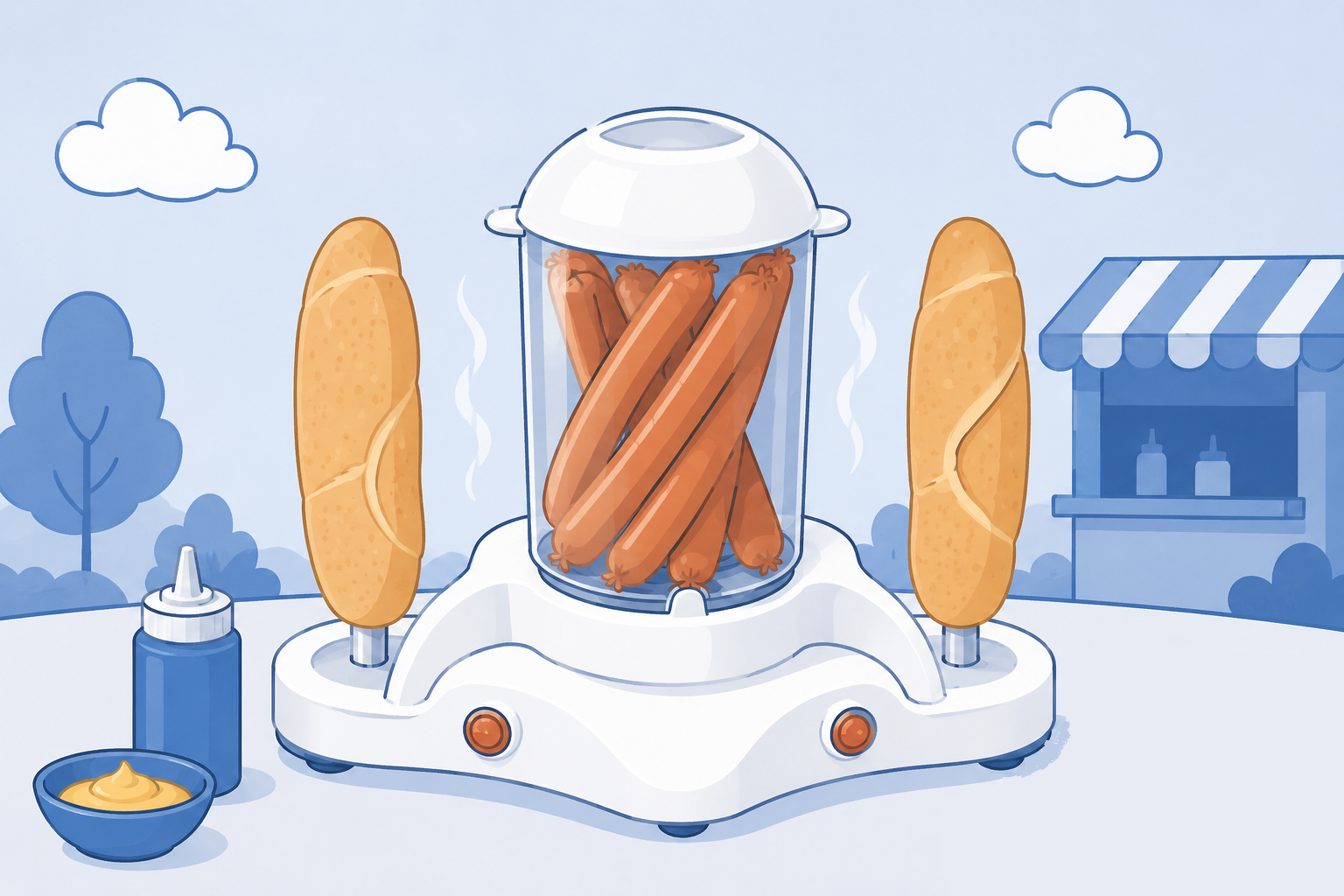
Famous Czech machine for párek v rohlíku…
Heat the sausage.
Slide it inside.
Add your sauces.
Try not to smile when you realise how little mess you've made.
The final verdict
So...
Which one is better?
That's entirely up to you.
If you love colorful toppings, caramelized onions, and endless combinations, the American hot dog is hard to beat. But if you've ever tried to eat one while walking, carrying a drink, and talking to your friend at the same time...
The Czech version suddenly starts making an awful lot of sense. Sometimes innovation doesn't look like a spaceship. Sometimes it looks like a hole in a bread roll.
One last Czech lesson
The singular is: párek v rohlíku
The plural is: párky v rohlíku
Not hot dogs. Because if you're in Czechia, you're not ordering a hot dog. You're ordering one of the country's most underrated inventions.
Ready to order like a local?
Whether you're visiting a pub, restaurant, bakery, a café, or a street food stand, knowing a few simple Czech phrases makes the whole experience much more fun and much less stressful.
If you'd like to order coffee, pastries, sandwiches, or even a párek v rohlíku with confidence, check out my Czech Survival Vocabulary Sheets. They're packed with natural dialogues, pronunciation tips, and real-life phrases you'll actually hear in Czechia.

Master the language of the Czech pub with this fun and practical survival guide. Learn how to drink order like a local, understand the mysterious world of beer pouring styles, and discover why grammar really does get easier after your fifth pint. From key phrases to cultural insights, this sheet gives you everything you need to survive (and enjoy) the legendary česká hospoda.

Master the art of dining out in Czechia with this handy Czech Restaurant: Survival Vocabulary guide. Packed with practical language tips, cultural insights, and real-life dialogues, it will help you navigate menus, order like a local, and avoid common faux pas.
The sheet comes as a PDF download, designed in a clean and print-friendly format — perfect to keep on your phone or print out and bring along to your next Czech food adventure.
Master Czech in the café – one cappuccino at a time!
This practical sheet is your survival guide to the Czech coffee shop jungle. Inside, you’ll discover:
Essential café vocabulary – from espresso to oat milk, learn how to order like a local.
Ready-to-use phrases – no grammar headaches, just sentences you can say right away.
Numbers made simple – understand why it’s dvě kávy but pět káv, with easy examples.
Cultural insights – what Czechs mean by pražská kavárna or kavárenský povaleč.
A real café dialogue – practice a short conversation with a barista.
Bonus: sample menu – so you know exactly what you’re ordering.
Perfect for beginners, this sheet combines culture, grammar, and real-life language so you can sit down in any Prague café with confidence.

Your quick guide to surviving Czech shops without crying in front of the cash register.
From the bakery to the butcher, from drogerie to papírnictví… this sheet will help you navigate every corner of the Czech shopping jungle. Learn how to ask for bread, buy shampoo, or politely say “Bez tašky, děkuju.”
Packed with real-life examples, useful phrases, grammar tips, and cultural notes (like why Czech cashiers never smile), this guide will turn your shopping trips from awkward to confident — one “Dobrý den” at a time.
Perfect for all Czech learners who want to sound natural, feel local, and finally survive that checkout moment like a pro.
