Czech Prepositions Unpacked: PRO vs. ZA
The Two Ways to Completely Mess Up “For” in Czech
If you’ve been learning Czech for more than five minutes, you’ve probably already fallen into this trap: You see “for” → you pick pro or za→ and boom, you’re wrong.
The problem is simple: English has one cozy little word — for. Czech looked at that and said: “No. Let’s make it complicated.” So let’s fix this once and for all.
The Core Idea (a.k.a. The Lifesaver)
PRO = for someone (benefit, recipient, purpose)
ZA = for something (exchange, reason, thanks, substitution, time)
If you remember nothing else, remember this:
PRO = who gets it
ZA = why / in exchange / because of what
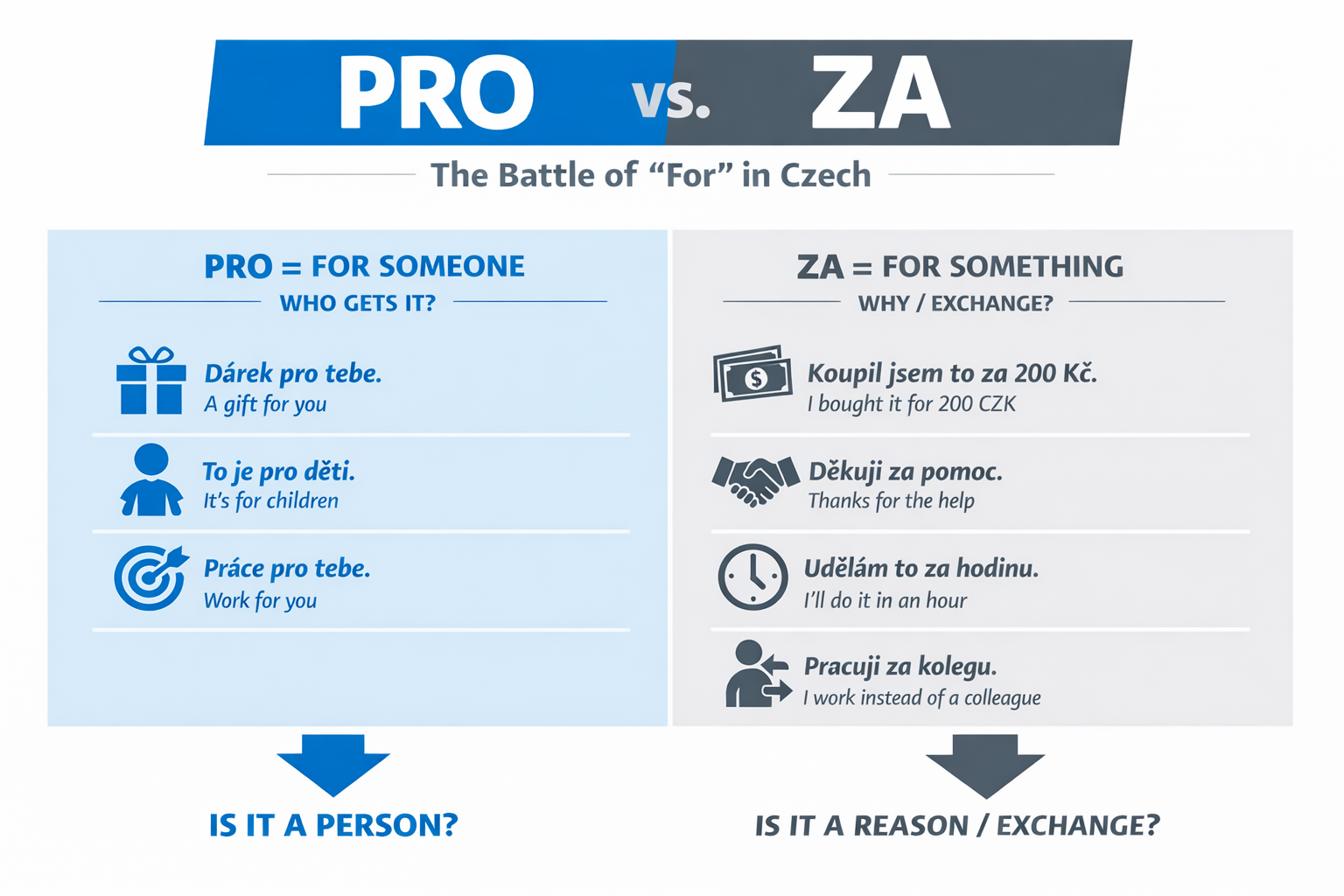
The battle of “FOR” in Czech.
Now let’s break it down with examples you’ll actually remember.
PRO = “for someone” (recipient / purpose)
Use prowhen something is intended for a person.
Typical situations:
gifts
messages
purpose / intended use
Examples:
Mám pro tebe dárek.
"I have a gift for you."Tohle je pro děti.
"This is for children."Koupil jsem to pro maminku.
"I bought it for my mom."Dělám to pro tebe.
"I’m doing this for you."
Think: Who benefits? → PRO
ZA = “for” as exchange (money, trade, price)
Use za when you mean in exchange for something.
Examples:
Koupil jsem to za 200 korun.
"I bought it for 200 crowns."Vyměnil jsem to za kávu.
"I exchanged it for coffee."Prodal auto za hodně peněz.
"He sold the car for a lot of money."
Think: What did you give to get it? → ZA
ZA = “for” after certain verbs (especially thanking!)
This is where students crash and burn.
In English: “Thank you for everything.”
Students go: Děkuji pro všechno. (NO. ABSOLUTELY NOT.)
Correct Czech:
Děkuji za všechno.
"Thank you for everything."
More examples:
Děkuji za pomoc.
"Thank you for the help."Omlouvám se za zpoždění.
"I apologize for the delay."Platím za tebe.
"I’m paying for you."
Think: reaction to something → ZA
ZA = time expressions (“in”, “during”, “for” time)
Czech loves using zafor time in ways that feel slightly illegal.
Examples:
Udělám to za hodinu.
"I’ll do it in an hour."Naučil jsem se to za týden.
"I learned it in a week."Za komunismu to bylo jiné.
"During communism, it was different."
Think: time frame → ZA
ZA = substitution (“instead of”, “on behalf of”)
Mluvím za něj.
"I speak for him."Pracuji za kolegu.
"I’m working for (instead of) a colleague."
Think: replacement → ZA
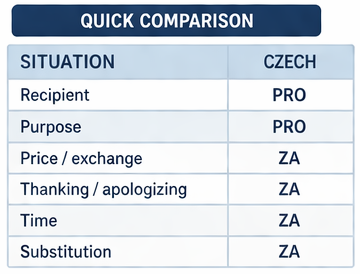
Quick comparison table of PRO and ZA
The Classic Mistake
This happens to Czech learners a lot: Koupil jsem to za tebe.
This means: “I bought it instead of you” (you were supposed to buy it, but I did)
If you mean “for you” (as a gift):
Koupil jsem to pro tebe.
"I bought it for you."
Another common one: Děkuji pro dárek.
If you want to say “Thank you for the present.” use Děkuji ti za dárek.
Want to finally stop guessing Czech prepositions? Grab my Czech Prepositions Cheat Sheet and see all the patterns clearly in one place.

Master Czech prepositions once and for all! This beautifully designed Czech Prepositions Cheat Sheet explains the logic behind Czech prepositions — where to use do, v/ve, z/ze, na, u, od, s, bez, po, nad, pod, před, za and more.
You’ll finally understand why it’s ve škole but do práce, and how Czechs use prepositions to show movement, position, and direction.
Includes easy visuals, grammar tips, real-life examples, and humor that makes it all stick.
Perfect for A1–B2 students who want to sound natural and confident in Czech.
